Q1 2026
Quarterly Market Report
Bitcoin Market
|
Mining Insights

Contents
01
Abstract
Market & Investors
Bitcoin's first quarter of 2026 tested investor conviction as prices fell approximately 23%, sentiment indicators shifted into defensive territory across both long and short term holder cohorts, and the market moved closer to its aggregate cost basis than at any point since the previous cycle. Amid the drawdown, regulatory clarity advanced with the SEC and CFTC issuing the first formal classification framework for digital assets, while institutional accumulation from the largest corporate holders continued uninterrupted


Mining Sector
The mining industry absorbed the full weight of the quarter's repricing, with hashprice falling to record lows, publicly listed miners liquidating Bitcoin at an unprecedented pace, and the network recording its first quarterly hashrate decline in six years. Breakeven thresholds tightened significantly even for the most efficient hardware, accelerating a broader industry pivot toward AI and high performance computing infrastructure that is reshaping the identity of publicly traded mining companies
02
BTC News

U.S. Supreme Court's Decision on Trump's Tariffs May Not Rock Crypto — Yet
The U.S. Supreme Court ruled 6-3 in February that President Trump's tariffs imposed under the International Emergency Economic Powers Act exceeded his legal authority, striking down the trade measures that had been in place since early 2025. The decision halted what had become one of the most aggressive uses of executive tariff power in modern history. Trump responded by announcing a replacement 10% global tariff under alternative statutory authority, later raising it to 15%, signaling that trade tensions would persist despite the court's rebuke

Strategy Posts $14.5 Billion Unrealized Loss in First Quarter
Strategy, the publicly traded company led by Michael Saylor, reported a $14.5 billion unrealized loss on its Bitcoin holdings for the first quarter of 2026 as the broader market declined. The loss reflected Bitcoin's approximately 23% drop during the period rather than any realized sale of holdings. Throughout the quarter, the company continued its accumulation program, adding approximately 80,000 BTC through a series of purchases funded by common stock sales and preferred share issuances. Q1 2026 ranked among Strategy's largest acquisition quarters on record, reinforcing its position as the largest publicly traded corporate holder of Bitcoin.

U.S. SEC Issues First-Ever Definitions for What Crypto Assets Are Securities
The U.S. Securities and Exchange Commission issued interpretive guidance in March establishing the first formal taxonomy for classifying crypto assets under federal law. The guidance, released jointly with the Commodity Futures Trading Commission, defines five categories of digital assets: digital commodities, digital collectibles, digital tools, stablecoins, and digital securities. Under the framework, only digital securities remain subject to securities laws, returning the SEC to what Chairman Paul Atkins described as its core statutory authority. The CFTC signed on to the same taxonomy as part of a broader push toward regulatory harmonization between the two agencies, which had formalized their cooperative relationship just days earlier through a memorandum of understanding.
News Commentary
The first quarter of 2026 presented a market caught between persistent macro uncertainty and meaningful structural progress. The Supreme Court's rejection of Trump's tariff authority removed one layer of trade policy risk but introduced new political complexity, as the administration's swift pivot to alternative tariffs kept broader economic conditions unsettled. Against that backdrop, Strategy's continued accumulation despite a $14.5 billion unrealized loss demonstrated institutional conviction operating independently of short term price action, reinforcing the thesis that large holders are positioning for longer time horizons rather than reacting to quarterly drawdowns. Meanwhile, the SEC and CFTC's joint asset classification framework marked a significant step toward the regulatory clarity the industry has sought for over a decade. Taken together, these developments suggest that while near term conditions remained challenging, the institutional and regulatory foundations underpinning Bitcoin continued to strengthen throughout the quarter
03
Long-Term Sentiment
Entity-Adjusted Net Unrealized Profit/Loss
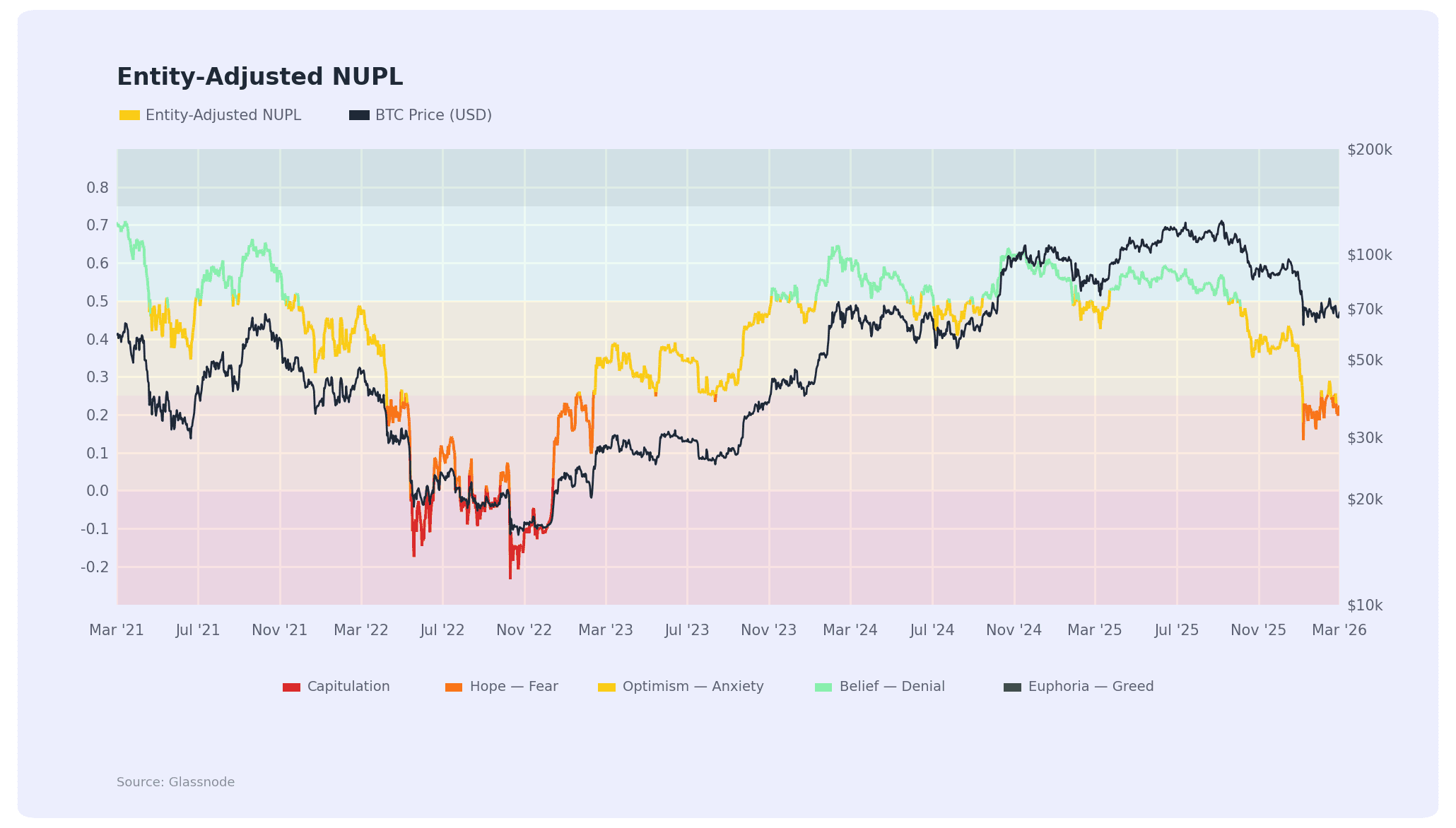
The Entity-Adjusted Net Unrealized Profit/Loss (NUPL) metric visualizes the average sentiment of Bitcoin investors by measuring the size of unrealized profit relative to the market cap. When NUPL is high, most investors are sitting on unrealized profits, suggesting optimism or even euphoria. When it turns negative, it reflects widespread unrealized losses, typically marking periods of capitulation. The color bands help highlight investor psychology over time
During the first quarter, NUPL continued the decline that began in the prior period, falling from approximately 0.40 at the start of January into the 0.15 to 0.20 range by late February before stabilizing near 0.20 by the end of March. This movement marked a transition out of the Optimism/Anxiety zone and into the Hope/Fear band, indicating that unrealized profits across the network contracted significantly as prices declined through the quarter. The depth of the move reflects a market where the aggregate investor is still in profit, but the cushion has narrowed considerably. NUPL has not reached these levels since the early stages of the 2023 recovery, suggesting that investor psychology has shifted from cautious optimism to a more defensive posture where further downside could begin to test conviction more broadly
Realized-Profit Loss Ratio
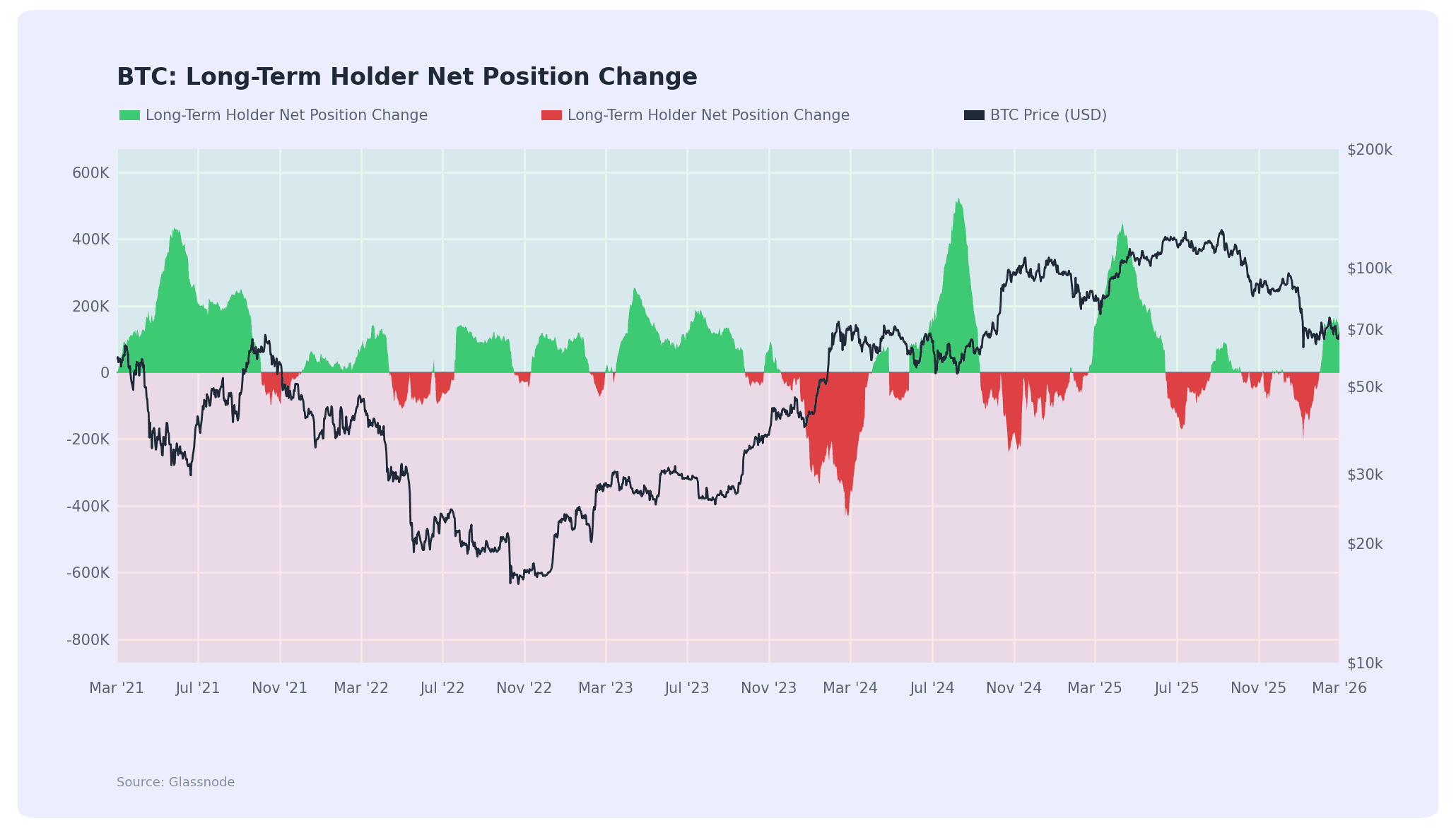
The Realized Profit/Loss (PnL) Ratio in logarithmic scale measures the aggregate USD value of profits versus losses realized by investors over time. When this ratio is above 1, the market is realizing more profits than losses, which is indicative of a confident or bullish environment. Conversely, a ratio below 1 indicates more coins are being sold at a loss, often aligned with bearish sentiment or capitulation. This version of the metric applies a 30-day moving average to smooth out short-term volatility and better identify market phases
Over the course of the first quarter, the Realized Profit/Loss Ratio deteriorated from readings predominantly above 1 in early January to increasingly loss-dominant territory by February. The February selloff produced some of the deepest red spikes observed since early 2023, reflecting a period where a meaningful share of coins moving on chain were being sold below their cost basis. By March, the ratio began oscillating closer to the neutral level of 1, with intermittent green and red readings suggesting a market transitioning from acute loss realization toward a more balanced state. The pattern points to a quarter where early confidence gave way to forced selling and capitulation, followed by a tentative stabilization as the worst of the drawdown passed
Long-Term Holder Net Position Change
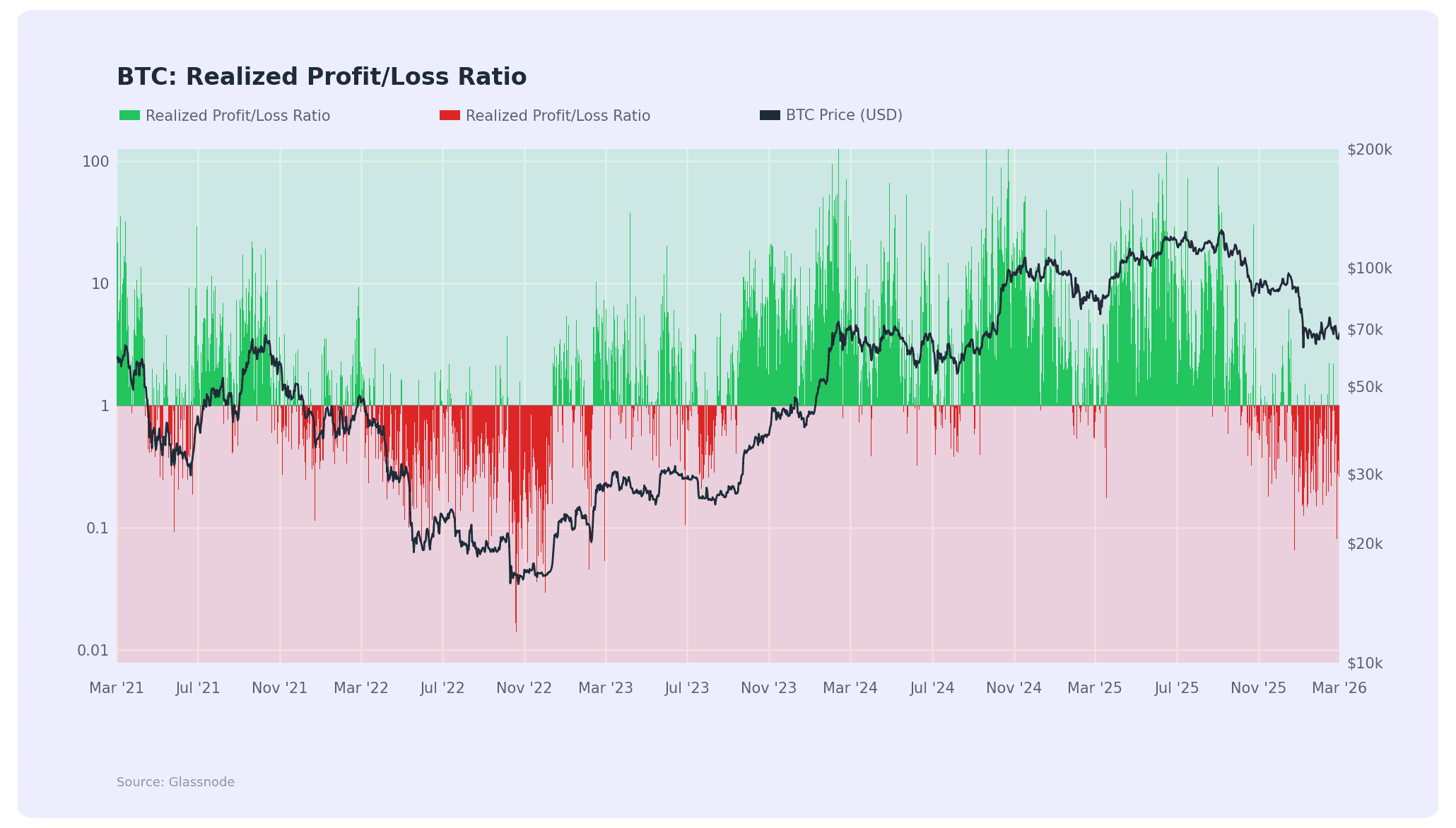
The Long-Term Holder (LTH) Net Position Change metric measures the 30-day net change in Bitcoin supply held by wallets that have held their coins for at least 155 days. When values are positive (green), it signals that LTHs are accumulating Bitcoin. Negative values (red) indicate that LTHs are distributing, often taking profits. Because LTHs are often viewed as strategic investors, their behavior is considered a strong indicator of broader market cycle phases.
Long term holder behavior shifted from modest accumulation at the start of January into sustained distribution as prices declined through February and March. The net position change turned negative by mid January and remained in distribution territory for much of the quarter, with 30 day net outflows reaching approximately 50,000 to 100,000 BTC during the heaviest periods. The shift represents a meaningful change from the accumulation posture that characterized much of mid 2025, though the magnitude of distribution remained moderate compared to the deep outflows observed during the 2024 cycle peak. The persistence of red readings throughout the quarter suggests that long term holders responded to falling prices by reducing exposure rather than adding to positions, a pattern more consistent with defensive repositioning than outright capitulation
Long-Term Holder Net Position Change
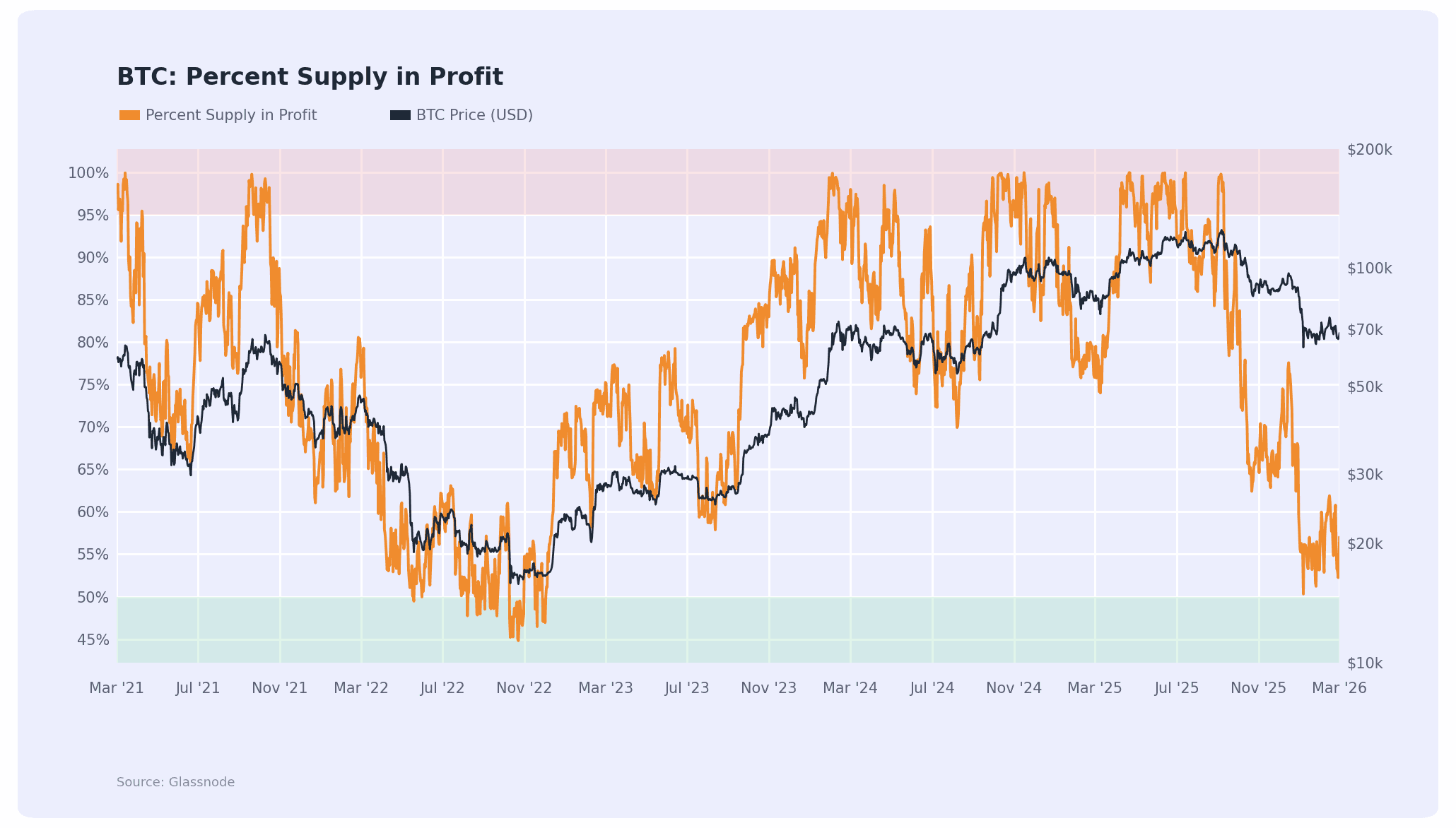
The Percent Supply in Profit chart shows the proportion of Bitcoin's circulating supply that is currently held at a profit. This means the current market price is higher than the price at which each coin last moved. This percentage acts as a broad indicator of market sentiment. High values usually reflect optimism or euphoria, while low values suggest capitulation or bearish conditions
The Percent Supply in Profit declined from approximately 85% at the start of January to roughly 60% to 65% by late February, before recovering modestly to approximately 65% by the end of March. The decline brought this metric to its lowest sustained level since the early stages of the 2023 bull market, reflecting the impact of the quarter's price drawdown on the broader holder base. At approximately 65%, the reading indicates that roughly one third of circulating supply is now held at an unrealized loss, a meaningful shift from the 90% and above levels observed during the mid 2025 highs. While the metric remains well above the sub 50% readings historically associated with deep bear markets and capitulation, the speed of the decline suggests that a substantial portion of supply was acquired at higher prices during the late 2024 and 2025 rally, and those holders are now underwater
Long Term Sentiment Commentary
Taken together, the long term sentiment indicators suggest the first quarter marked a transition from cautious optimism into a more defensive phase of the cycle. NUPL's decline into the Hope/Fear zone, the Realized Profit/Loss Ratio's shift below neutral, falling supply in profit, and sustained LTH distribution all point to an environment where the aggregate market moved from absorbing gains to managing losses. The consistency across all four metrics reinforces the signal: this was not a single metric diverging, but a broad based deterioration in investor positioning. However, the absence of readings associated with deep capitulation, NUPL remained positive, the Realized P/L Ratio stabilized near 1 by March, and supply in profit held well above 50%, suggests the market entered a period of stress and repricing rather than a structural breakdown. The quarter's data implies a market that is recalibrating expectations rather than unwinding entirely, with conditions that could either resolve into a recovery or deepen depending on whether external pressures continue to weigh on risk sentiment
04
Short-Term Sentiment
Entity-Adjusted STH-NUPL
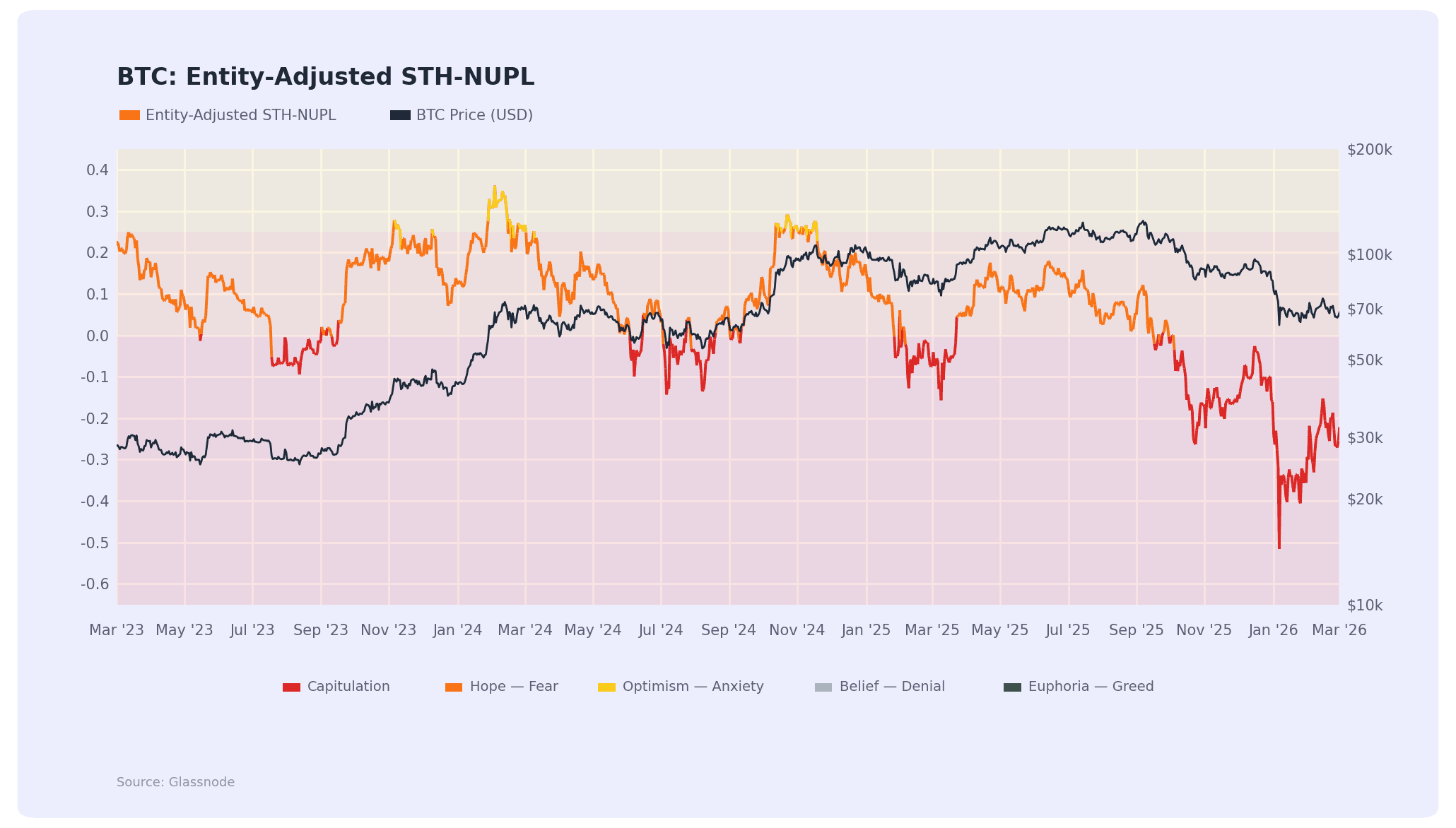
This metric captures the net unrealized profit or loss of Bitcoin held by short-term holders, defined as entities that acquired their coins within the last 155 days. It is calculated by comparing the current market value of short-term holder coins to their cost basis. Positive values indicate that these holders are sitting on unrealized profits, while negative values suggest they are underwater. Because short-term holders are more likely to react emotionally to price swings, this metric provides insight into speculative sentiment and can help identify local tops and bottoms in the market
STH-NUPL entered the quarter barely positive at approximately 0.05, indicating that recent buyers were only marginally in profit as January began. The metric crossed below zero within the first weeks of the year and declined sharply through February, reaching approximately -0.15 to -0.20 as the selloff pushed short term holders deep underwater. This placed the reading firmly in the Capitulation zone, a level not sustained since the 2022 bear market. By the end of March, STH-NUPL had recovered slightly but remained negative at approximately -0.10 to-0.15, indicating that the average short term holder was still carrying unrealized losses. The persistence of negative readings throughout most of the quarter reflects a speculative cohort under sustained pressure, where the cost basis of recent entrants sat well above prevailing market prices
Realized-Profit Loss Ratio
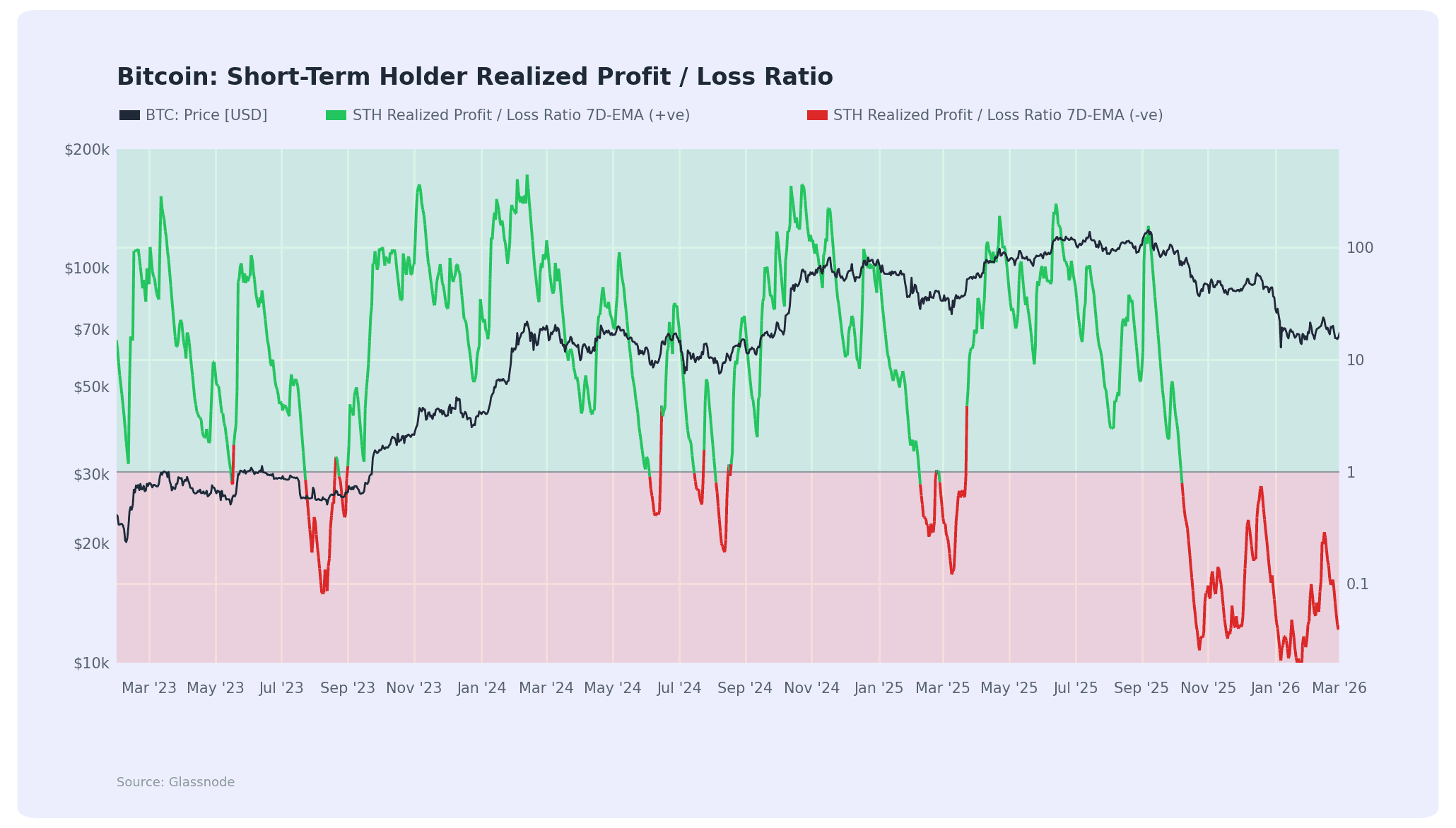
This metric measures the ratio between realized profits and realized losses for short-term holders (STHs), defined as addresses holding BTC for less than 155 days. A ratio above 1 means STHs are realizing more profit than loss, indicating a risk-on or bullish sentiment. A ratio below 1 signals more losses than profits, typically reflecting capitulation or a loss of confidence. Because short-term holders are more sensitive to price movements, this metric offers a real-time view of how speculative participants are behaving and how they are responding to prevailing market conditions
The STH Realized Profit/Loss Ratio collapsed during the first quarter, producing some of the most extreme loss dominant readings on the three year chart. In January, the ratio hovered near neutral before deteriorating as prices weakened. The February selloff drove the ratio to approximately 0.05 to 0.10, reflecting a period where short term holders were realizing losses at a rate far exceeding any profit taking. These readings were comparable in depth to the worst episodes of the 2022 bear market within the visible chart history. March brought a partial recovery as the ratio climbed back toward 0.5, though it remained below 1 for most of the month. The pattern reveals a quarter where speculative participants moved from cautious positioning to acute capitulation before entering a stabilization phase, with confidence among recent buyers still far from restored
Short-Term Sentiment Commentary
The short term sentiment metrics paint a picture of a speculative cohort that absorbed the worst of the quarter's drawdown. STH-NUPL's sustained negative readings confirm that recent buyers remained underwater throughout most of the period, while the collapse in the STH Realized Profit/Loss Ratio shows that those who did sell were overwhelmingly doing so at a loss. The severity of the February readings in both metrics indicates that the selloff disproportionately impacted participants who entered during the late 2025 rally, many of whom appear to have either exited at a loss or are now holding through significant drawdowns. The modest recovery in March suggests that the most acute selling pressure has subsided, but the continued negative STH-NUPL readings indicate that speculative sentiment has not yet turned constructive. For this cohort to shift from defensive to opportunistic, prices would likely need to reclaim levels closer to the short term holder cost basis, which currently sits in the range of approximately $80,000 to $85,000
05
Pricing Models
Realized Price and MVRV
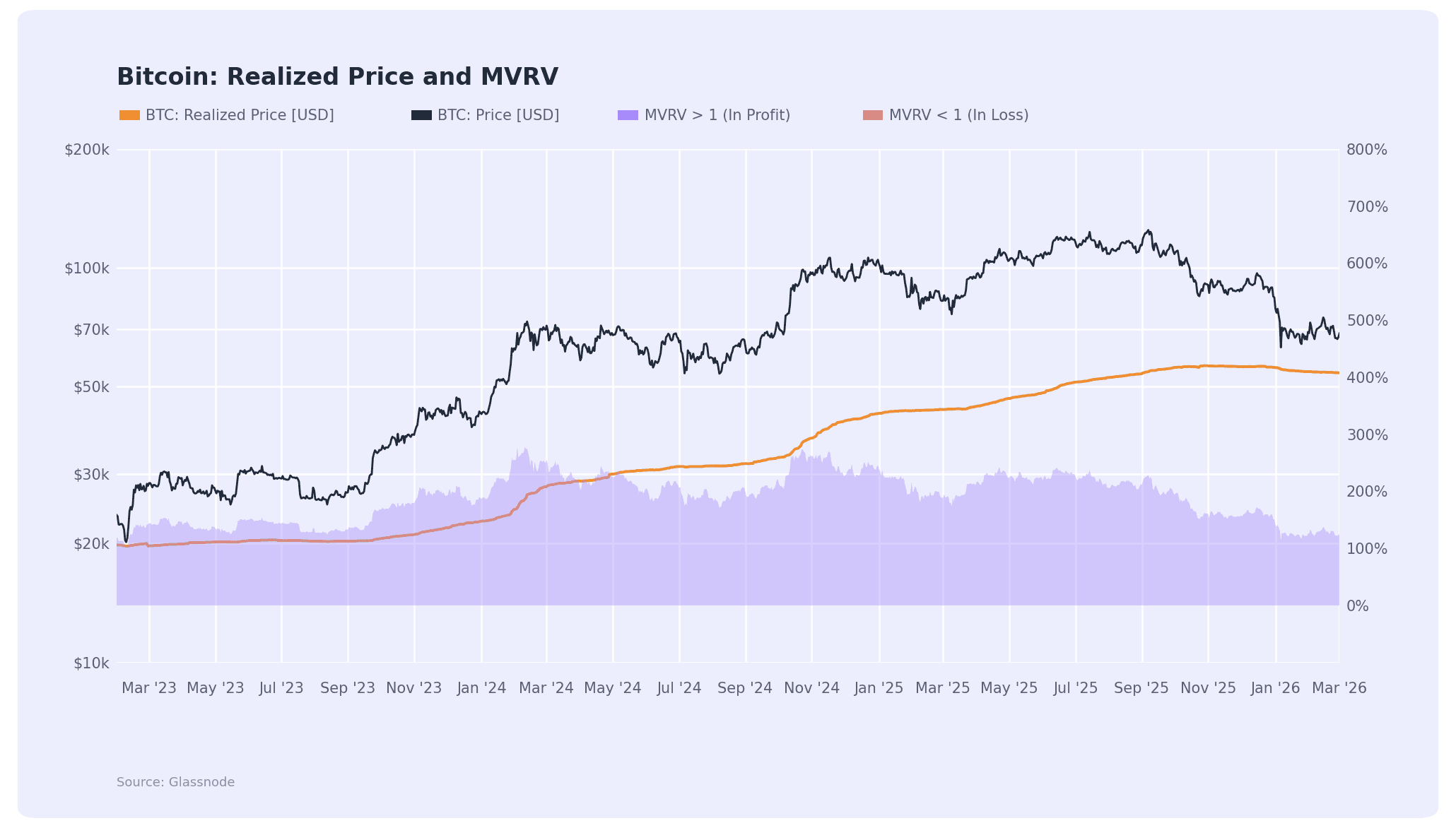
The Realized Price represents the average cost basis of the Bitcoin market and often acts as a foundation during periods of correction, while the Market Value to Realized Value (MVRV) ratio compares market value to that cost basis to gauge overall valuation extremes. MVRV values above 1 indicate that the market is, on average, in profit, while readings above 2.5 have historically coincided with overheated conditions and cycle tops. Together, these metrics illustrate how far market pricing has moved from its aggregate cost structure and help identify periods of either undervaluation or excess
Realized Price continued its gradual ascent through the first quarter, rising to approximately $50,000 to $55,000, while market price declined from approximately $88,700 at the start of January to approximately $68,200 by the end of March. The result was a significant compression of the MVRV ratio, which fell from elevated readings earlier in the cycle toward a range closer to 1.2 to 1.3. While MVRV remained above 1 throughout the quarter, confirming that the aggregate market is still in profit, the narrowing gap between market price and realized price reflects a market that has moved meaningfully away from overheated conditions. With market price ending the quarter only approximately 20% to 30% above realized price, the valuation cushion has thinned considerably from the levels seen during the 2024 and early 2025 rally. The current configuration sits well below the 2.5 threshold historically associated with cycle tops, positioning the market closer to fair value territory than at any point since the early stages of the current cycle
Bitcoin: Long-Term vs Short-Term Holder Cost Basis
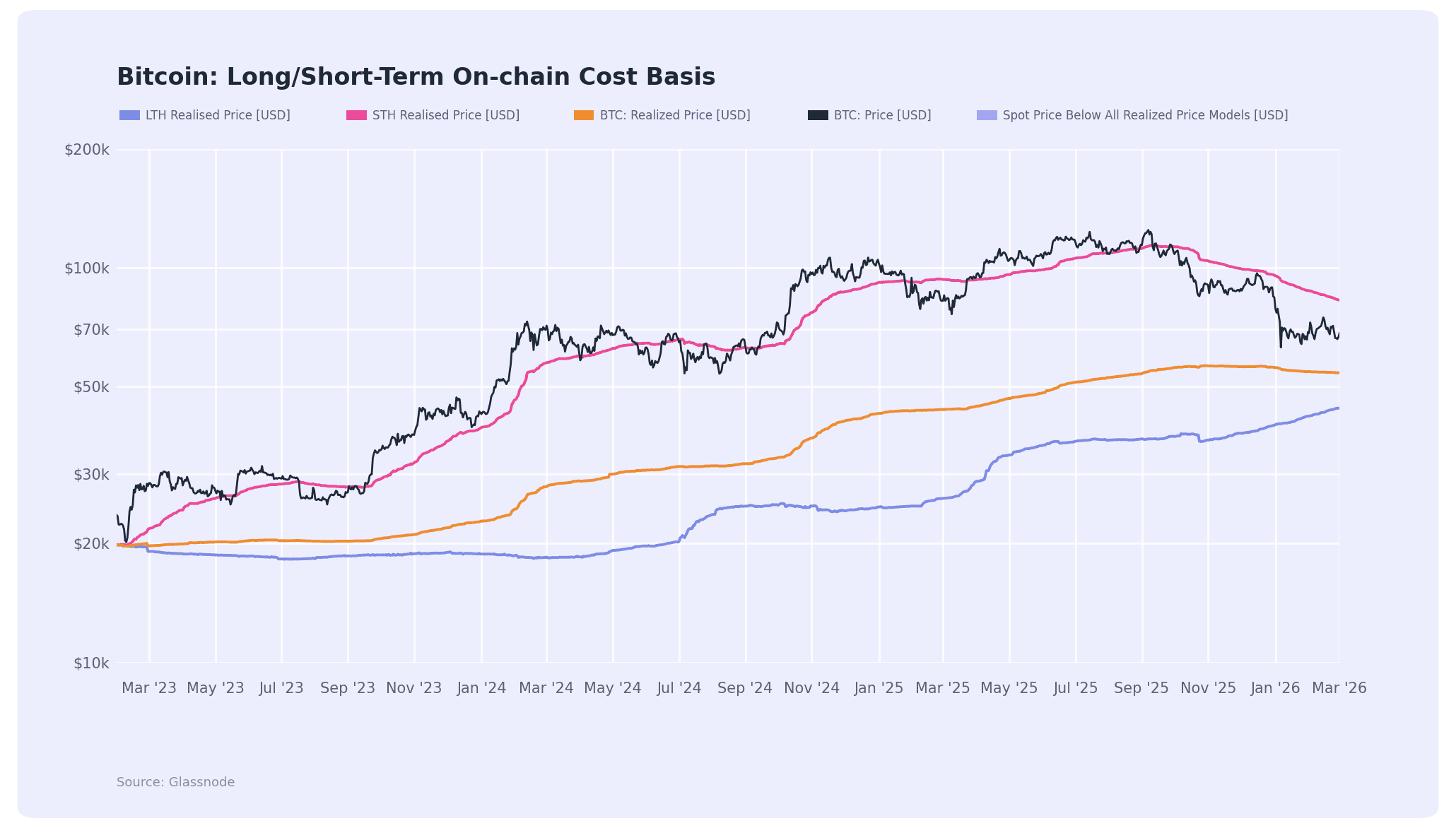
The Long/Short-Term Holder Cost Basis model compares the average purchase price of two distinct investor groups. Long-term holders (LTHs), who have held their Bitcoin for more than 155 days, typically represent market conviction and macro support levels, while short-term holders (STHs), who acquired coins within the past 155 days, reflect more reactive and speculative sentiment. When the current price trades above the STH cost basis, it signals that recent investors are in profit, which often correlates with bullish momentum. Conversely, when the price falls below the STH cost basis, it indicates newer buyers are underwater and may panic sell. Meanwhile, the LTH cost basis tends to act as a strong floor in bear markets, rarely breached unless under extreme stress
The most significant development in this model during the first quarter was the market price crossing below the short term holder cost basis, which sat in the range of approximately $80,000 to $85,000. This crossover confirmed the shift in speculative sentiment visible in the short term metrics, with recent buyers now holding at an aggregate loss. The LTH cost basis, by contrast, remained far below at approximately $30,000 to $35,000, preserving a substantial profit cushion for long term participants and continuing to act as a structural floor well beneath current prices. The aggregate realized price held near $50,000 to $55,000, maintaining the market's overall profit position. The wide spread between the LTH and STH cost bases, approximately $50,000, underscores the divergent conditions facing these two cohorts: long term holders retain significant unrealized gains while short term holders are absorbing meaningful drawdowns. This configuration historically creates an environment where price action is driven more by short term holder behavior, as they face the greatest pressure to either sell or hold through further volatility
Pricing Model Commentary
The pricing model data confirms that the market ended the first quarter in a structurally ambiguous position. MVRV's compression toward the low end of its positive range removes the overheated signal that characterized earlier phases of the cycle, but the ratio's persistence above 1 indicates the market has not yet reached the kind of deep undervaluation that has historically preceded major reversals. The more actionable signal comes from the cost basis model, where the breakdown below the STH realized price creates a well defined threshold for recovery. A sustained reclaim of the $80,000 to $85,000 range would put short term holders back in profit and likely shift the speculative tone from defensive to constructive. Until that level is reclaimed, the market sits in a zone where short term holders face ongoing pressure while long term holders remain comfortably above their cost basis, a dynamic that favors sideways consolidation over a sustained move in either direction
06
News
Bitcoin Mining
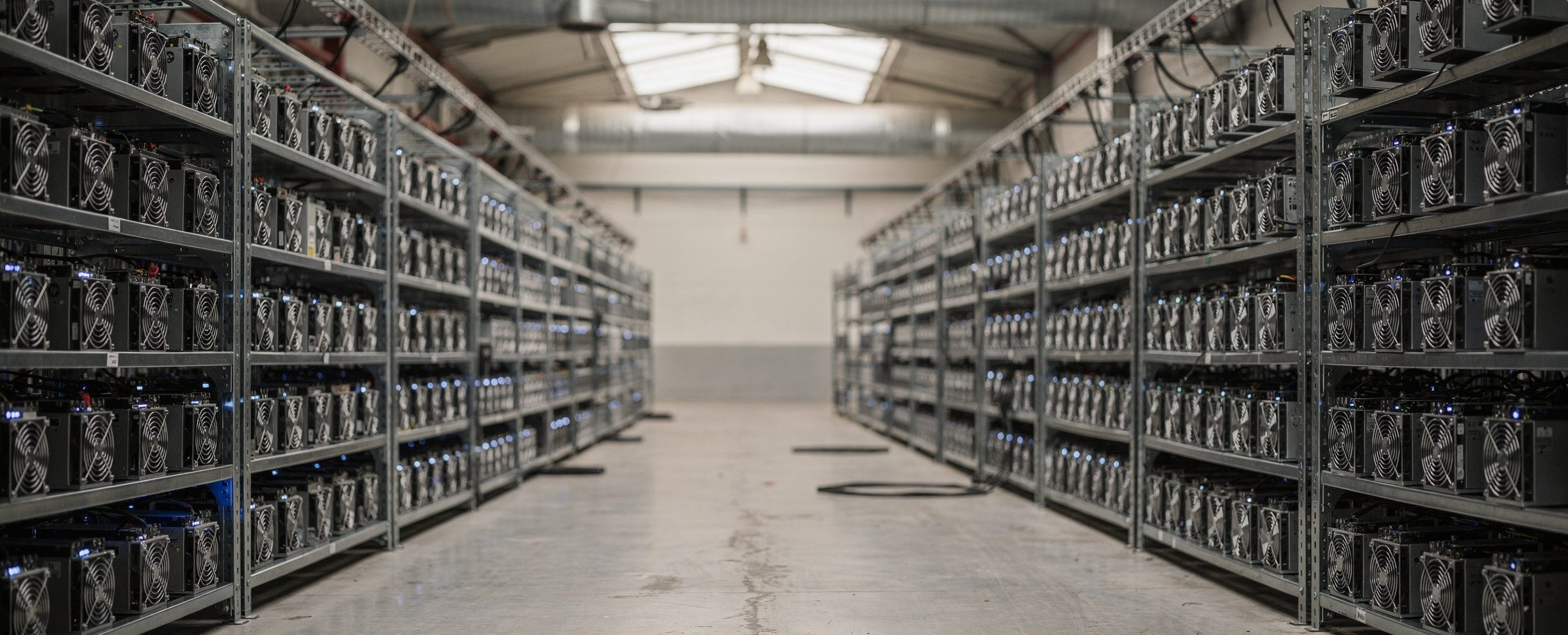
Major Bitcoin Mining Companies Sold More BTC in Q1 2026 Than All of 2025
Publicly listed Bitcoin mining companies, including MARA, CleanSpark, Riot, Cango, Core Scientific, and Bitdeer, collectively sold more than 32,000 BTC during the first quarter of 2026, exceeding the total volume sold across all four quarters of 2025. The quarterly figure also surpassed the previous single quarter record of 20,000 BTC set during Q2 2022, when the Terra/Luna collapse triggered widespread industry stress. Hashprice fell to record lows near $33 per petahash per second per day, placing approximately 20% of the mining industry in unprofitable territory. CoinShares noted in its Q1 mining report that further capitulation among higher cost operators is expected in the first half of 2026 unless Bitcoin's price recovers materially
Bitcoin Hashrate Posts First-Quarter Drop for First Time in 6 Years as Miners Pivot to AI
Bitcoin's network hashrate declined approximately 4% during the first quarter, marking the first Q1 drop since 2020 and breaking five consecutive years of double digit first quarter growth. The hashrate had peaked at approximately 1.1 zettahash per second in October 2025 before declining to 826 exahash per second in February as prices fell and margins turned negative. By the end of March, hashrate had recovered to approximately 1 zettahash per second. The decline reflects a shift in capital allocation among publicly listed miners, many of whom are redirecting investment toward artificial intelligence and high performance computing infrastructure, where returns are higher and more predictable than current mining economics allow


AI Boom Spurs Bitcoin-Sales Threat at Miners Holding $8 Billion
Publicly traded Bitcoin miners collectively held approximately $8 billion in Bitcoin on their balance sheets as the artificial intelligence infrastructure boom created growing pressure to liquidate reserves. The transition toward AI and high performance computing requires significant upfront capital investment, and miners have increasingly turned to selling their Bitcoin treasuries to fund the conversion. The trend has accelerated as mining economics have deteriorated, with production costs for publicly listed miners exceeding market prices, making the decision to sell mined Bitcoin and redirect capital toward higher margin AI workloads a matter of operational survival for many operators
News Commentary
The mining industry entered 2026 facing the most challenging margin environment since the post-halving adjustment period, and the first quarter confirmed that operators are responding with a fundamental shift in strategy. Record Bitcoin liquidations, the first quarterly hashrate decline in six years, and the accelerating pivot toward AI infrastructure all point to an industry that is repricing the economics of pure play Bitcoin mining. The convergence of production costs above market price, record low hashprice, and the availability of higher margin alternatives in AI and HPC has created conditions where holding mined Bitcoin is no longer a viable default strategy for most public operators. While these dynamics create near term sell pressure on Bitcoin from a historically significant source of supply, the resulting decline in hashrate and reduction in network competition could ultimately benefit the miners who remain committed to the sector by improving their share of block rewards and reducing the difficulty environment over time.
Mining Introduction
Bitcoin opened the first quarter at approximately $88,700 and closed at approximately $68,200, a decline of roughly 23%. Network difficulty fell from approximately 636T to approximately 575T over the same period, a reduction of approximately 10%, reflecting the exit of less efficient operators and the reallocation of mining capital toward other business lines. Hashprice, which measures the expected daily revenue per unit of hashrate, declined from approximately $38.00/PH/s at the start of January to approximately $32.00/PH/s by the end of March. The combination of falling prices and compressing miner revenue created the tightest operating conditions the industry has faced since the April 2024 halving
The ASIC hardware market reflected these pressures across all efficiency tiers. High efficiency machines rated under 19 J/TH fell from $15.00/TH to $4.15/TH, a decline of approximately 72%. Mid tier units in the 19 to 25 J/TH range experienced the steepest drop, falling from $12.30/TH to $2.03/TH, a decline of approximately 83%. Older generation machines rated 25 to 38 J/TH declined from $3.06/TH to $1.40/TH. The severity of the repricing in the mid tier segment suggests that demand for previous generation hardware has largely collapsed, as operators either upgrade to the latest generation machines or exit mining entirely. At current hashprice levels, only the most efficient rigs running on low cost power remain economically viable.
07
Mining Dashboard
Bitcoin: Difficulty per Issuance Pricing Model
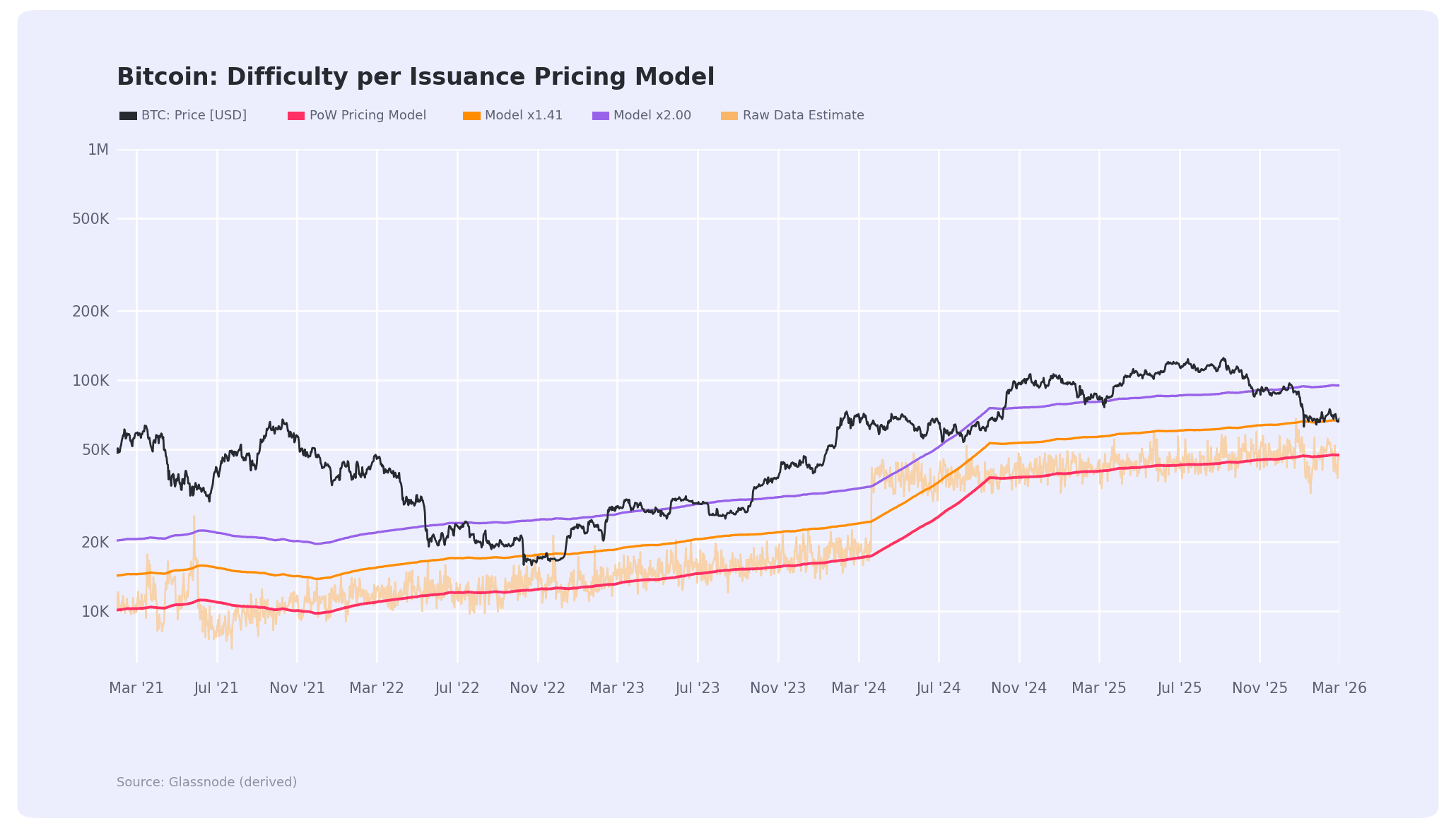
The Difficulty per Issuance Pricing Model is a miner-centric valuation tool that establishes a lower bound estimate for Bitcoin's fair value by combining two key variables: network difficulty and issuance rate. Difficulty reflects the computational effort required to mine blocks, serving as a proxy for capital investment and network security. Issuance refers to the number of new BTC created through mining, which diminishes over time as halvings occur. This model uses a smoothed average of difficulty and adjusts for reduced issuance, yielding a dynamic cost-floor estimate that reflects the production pressures on miners. As difficulty rises and issuance drops, the modeled price increases, anchoring the long-term market structure to miner behavior and economic feasibility.
The base PoW Pricing Model rose from approximately $45,700 to $47,400 during the first quarter, continuing its steady upward trajectory even as market price declined. The x1.41 band climbed from approximately $64,400 to $66,800, while the x2.00 band rose from approximately $91,300 to $94,700. The most notable development was the convergence of market price toward the x1.41 band. Bitcoin opened the quarter at $88,700, well above the x1.41 level, but closed at approximately $68,200, leaving only about $1,400 of separation between spot price and this historically significant support zone. The x2.00 band, which sat near $94,700 by quarter end, now represents a level that price would need to reclaim to signal a return to mid cycle conditions. The narrowing gap between price and the modeled production floor suggests that miners are operating closer to their cost basis than at any point since the model's lower bands were last tested during the 2022 bear market
BTC: Miner Net Position Change
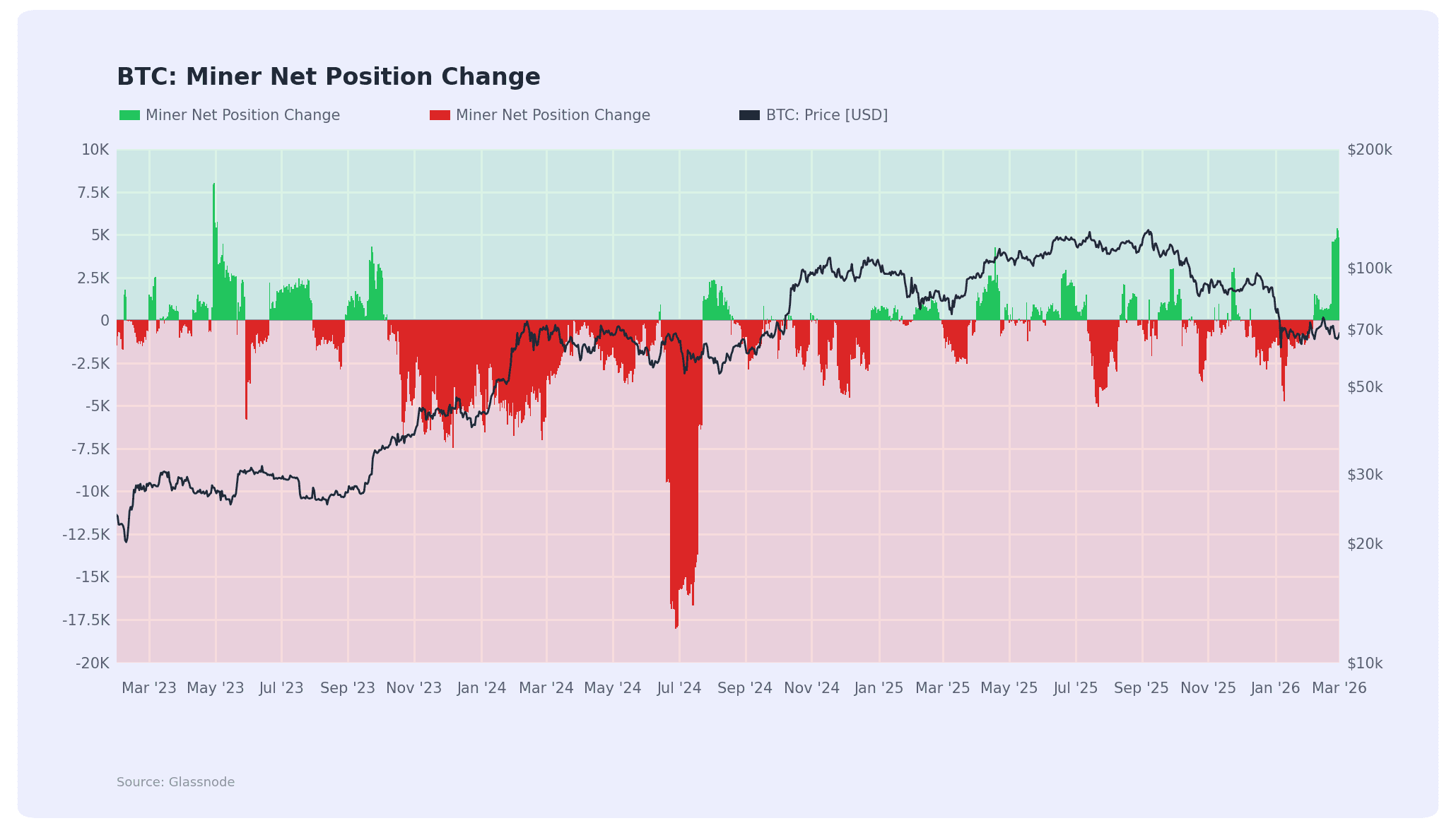
The Miner Net Position Change metric captures the 30-day rolling change in the Bitcoin balances of miner wallets. A positive value suggests miners are accumulating BTC, either by holding newly mined coins or withdrawing fewer from treasury. A negative value reflects distribution, typically selling to meet operational costs or capitalize on favorable prices. As miners are a consistent source of natural sell pressure, their behavior offers critical insight into macro supply dynamics. Accumulation implies long-term confidence and reduced immediate sell pressure, while distribution can create headwinds during uptrends or signal underlying stress during drawdowns.
The first quarter was predominantly characterized by miner distribution, consistent with the record selling activity reported across publicly listed operators. Daily readings remained negative through most of January and February, with net outflows reaching approximately -2,600 to -2,900 BTC per day in mid to late January and deepening to approximately -4,700 BTC per day in early February as Bitcoin fell toward $70,000. The scale and persistence of these outflows reflect an environment where miners were actively liquidating to cover operational shortfalls as production costs exceeded market price. By March, daily readings shifted into positive territory, with accumulation readings reaching approximately +4,800 BTC per day by the end of the month, though this reversal should be read in the context of two prior months of sustained sell pressure. The shift likely reflects a combination of weaker operators having already exited or exhausted their sellable reserves, and the remaining miners beginning to hold newly produced coins as prices stabilized.
Bitcoin: ASIC Rig Profitability (Antiminer S21 Pro)
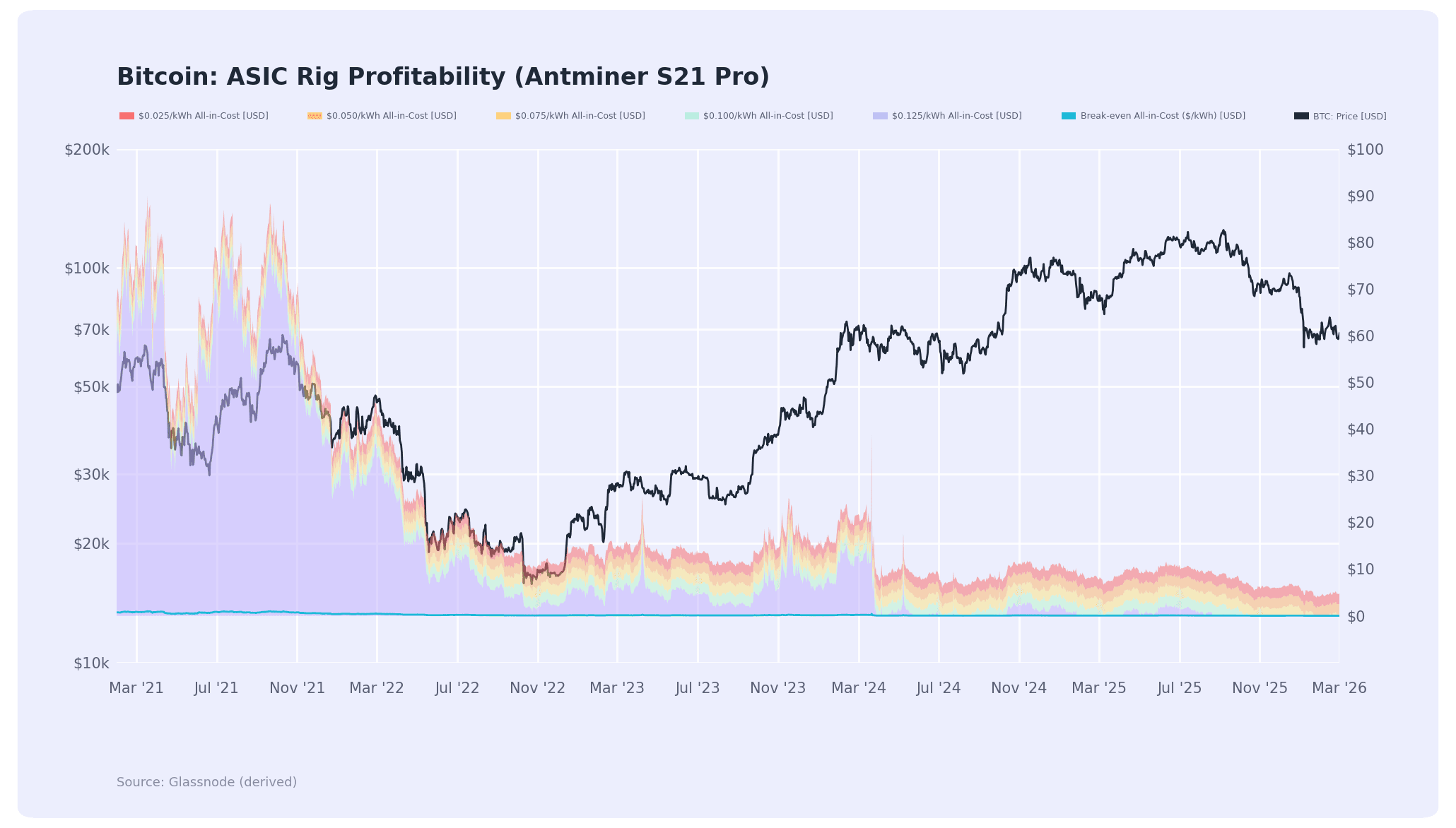
The ASIC Rig Profitability metric for the Bitmain Antminer S21 Pro tracks estimated daily profits under various all-in energy cost assumptions, ranging from $0.025 to $0.125 per kWh. It calculates profitability by subtracting the rig's daily operating cost from its estimated block reward revenue based on a 218 TH/s hashrate and 3662W power consumption. Each band in the chart represents profitability at a different energy price point. This model is crucial for identifying breakeven thresholds and evaluating miner health under changing market conditions, especially across varying operational cost environments.
Profitability compressed across all energy cost tiers during the quarter. At $0.05/kWh, a representative industrial rate, daily profit per unit fell from $4.63 to $3.32, a decline of approximately 28% but still comfortably above breakeven. At $0.075/kWh, the lower bound of what is generally considered retail territory, profitability dropped from $2.53 to $1.21, leaving margins thin but still positive. At $0.08/kWh, estimated daily profit fell to roughly $0.79, a level that leaves almost no margin for operational variability. The $0.10/kWh tier crossed from marginally profitable at $0.42 per day into negative territory at -$0.90, confirming that operators at this cost level can no longer sustain operations with the S21 Pro. The overall breakeven threshold fell from approximately $0.105/kWh at the start of the quarter to approximately $0.089/kWh by the end of March. This compression means that even operators running the most efficient current generation hardware are unprofitable above roughly 9 cents per kilowatt hour, a significant narrowing from the 10.5 cent threshold that applied just three months earlier.
Mining Dashboard Commentary
The mining dashboard data reveals a quarter defined by margin compression and strategic adaptation. The Difficulty per Issuance model's rising production floor, now within $1,400 of spot price at the x1.41 band, confirms that market pricing has converged on miner cost structures to a degree not seen since the depths of the previous cycle. The ASIC profitability data reinforces this, with breakeven thresholds tightening from $0.105/kWh to $0.089/kWh and the gap between industrial and retail operator viability narrowing to the point where even modest energy cost differences determine survival. Against this backdrop, the shift in miner net position from distribution to accumulation by March offers a counterpoint: the operators that remain active appear to be positioning with renewed conviction rather than continuing to liquidate. This combination of conditions, compressed margins alongside selective accumulation, suggests that the mining industry may be approaching the end of its post-halving shakeout, with the weakest operators already flushed out and the survivors better positioned to benefit from any recovery in price or decline in network competition
Conclusion
The first quarter of 2026 was defined by a broad repricing of risk across the Bitcoin market. Price declined approximately 23%, on chain sentiment indicators deteriorated across both long and short term holder cohorts, and valuation metrics compressed toward levels not seen since the early stages of the current cycle. NUPL fell into the Hope/Fear zone, the Realized Profit/Loss Ratio shifted below neutral, and approximately one third of circulating supply moved into unrealized loss. Short term holders were particularly exposed, with their aggregate cost basis near $80,000 to $85,000 sitting well above market price for most of the quarter. Despite these pressures, the market avoided the kind of deep capitulation readings historically associated with cycle bottoms, and regulatory developments including the SEC and CFTC's joint asset classification framework continued to build the structural foundation for the next phase of institutional participation.
The mining industry faced its most challenging margin environment since the April 2024 halving. Bitcoin's decline to approximately $68,200 pushed spot price within $1,400 of the Difficulty per Issuance model's x1.41 band, while hashprice fell to approximately $32.00/PH/s and breakeven thresholds for the S21 Pro tightened from $0.105/kWh to $0.089/kWh. Publicly listed miners responded with record Bitcoin liquidations exceeding 32,000 BTC, the network posted its first quarterly hashrate decline in six years, and the industry's accelerating pivot toward AI and high performance computing infrastructure signaled a fundamental shift in how operators are positioning their businesses. The late quarter reversal in miner net position from distribution to accumulation suggests that the post-halving shakeout may be nearing its end, with weaker operators already flushed out and the remaining participants better positioned to absorb the current environment while waiting for conditions to improve