Q4 2025
Quarterly Market Report
Bitcoin Market
|
Mining Insights

Contents
01
Abstract
Market & Investors
The fourth quarter of 2025 was a challenging period for Bitcoin and the broader digital asset market, marked by falling prices, weakening sentiment, and tighter conditions across the ecosystem. Bitcoin moved toward its first annual decline since 2022 as macroeconomic pressure and reduced risk appetite weighed on markets, even as institutional infrastructure and regulatory clarity continued to advance.


Mining Sector
On-chain data showed growing stress among both short-term and long-term holders, while miners faced declining revenues and rising costs. Rather than a capitulation event, the quarter reflected a broad repricing and consolidation phase, setting a more cautious tone heading into the next stage of the cycle.
02
BTC News

“Japan Government to Support Big Banks’ Project to Issue Stablecoins”
Japan’s government and financial regulators publicly backed a pilot initiative allowing major domestic banks to issue regulated stablecoins. The project is aimed at improving cross-border payments and settlement efficiency while keeping issuance and reserves fully within Japan’s existing banking and compliance framework. The move positions stablecoins as an extension of the traditional financial system rather than a parallel alternative.

“Bitcoin Set for First Annual Loss Since 2022 as Macro Pressures Weigh on Crypto”
Bitcoin moved toward its first negative annual return in three years as restrictive monetary policy, a strong U.S. dollar, and reduced risk appetite weighed on prices. The decline occurred despite continued institutional participation and regulatory progress, highlighting the growing influence of macroeconomic conditions on Bitcoin’s short-term performance.

“Investors Pull Record $523 Million From BlackRock’s Flagship Bitcoin ETF”
Late in Q4, investors withdrew a record single-day amount from BlackRock’s spot Bitcoin ETF, reflecting heightened volatility and tactical repositioning by institutional allocators. The outflows followed earlier periods of strong inflows and appeared driven by portfolio rebalancing rather than a loss of confidence in regulated Bitcoin investment products.
News Commentary
The fourth quarter of 2025 underscored the widening gap between Bitcoin’s short term market performance and its longer term institutional integration. Bitcoin’s slide toward its first annual loss since 2022 reflected sustained macroeconomic pressure rather than a deterioration in adoption fundamentals, as price action increasingly tracked global liquidity conditions and shifts in investor risk tolerance.
At the same time, institutional behavior signaled maturation rather than retreat. Volatile ETF flows late in the quarter showed allocators actively managing exposure within diversified portfolios, treating Bitcoin less as a speculative bet and more as a macro sensitive asset. On the policy front, Japan’s endorsement of bank issued stablecoins reinforced the broader trend toward embedding digital assets within regulated financial infrastructure. Together, these developments point to a market in transition where short term performance remains constrained by macro forces, while institutional adoption and regulatory alignment continue to advance steadily beneath the surface.
03
Long-Term Sentiment
Entity-Adjusted Net Unrealized Profit/Loss
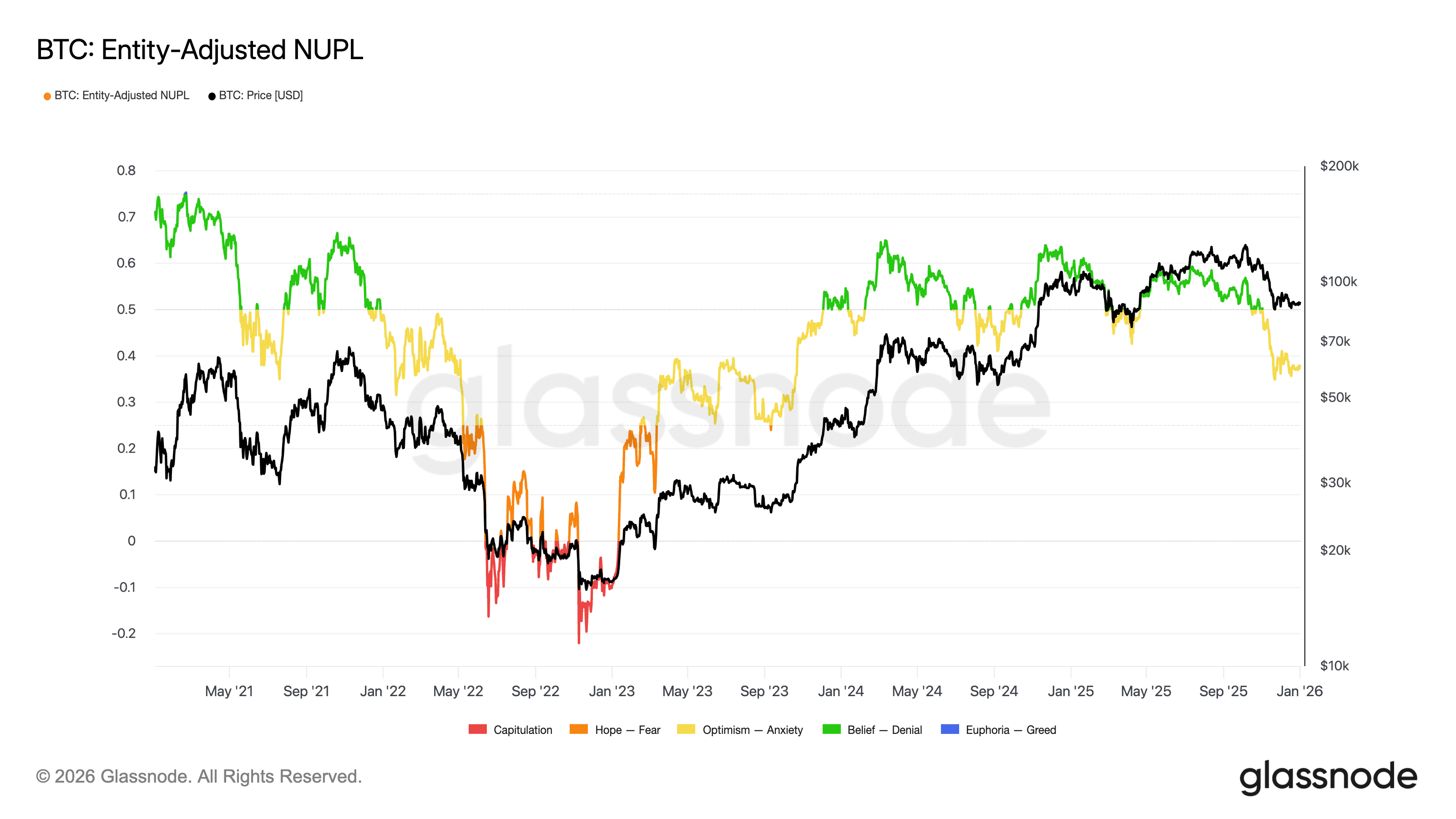
The Entity-Adjusted Net Unrealized Profit/Loss (NUPL) metric visualizes the average sentiment of Bitcoin investors by measuring the size of unrealized profit relative to the market cap. When NUPL is high, most investors are sitting on unrealized profits, suggesting optimism or even euphoria. When it turns negative, it reflects widespread unrealized losses, typically marking periods of capitulation. The color bands help highlight investor psychology over time.
During Q4 2025, Entity Adjusted NUPL declined meaningfully, falling from approximately the mid 0.50 range toward the 0.35 to 0.40 level by the end of the quarter. This movement marked a transition from the Belief zone into the Optimism/Anxiety range, in this case anxiety, reflecting a material reduction in unrealized profits as prices corrected and volatility increased. While NUPL remained positive overall, the downward trend indicates that a growing portion of market participants experienced diminishing profit cushions. The absence of a move into neutral or negative territory suggests that losses were not yet widespread across the investor base, but the sustained drift lower highlights increased sensitivity to price movements as unrealized gains compressed.
Realized-Profit Loss Ratio
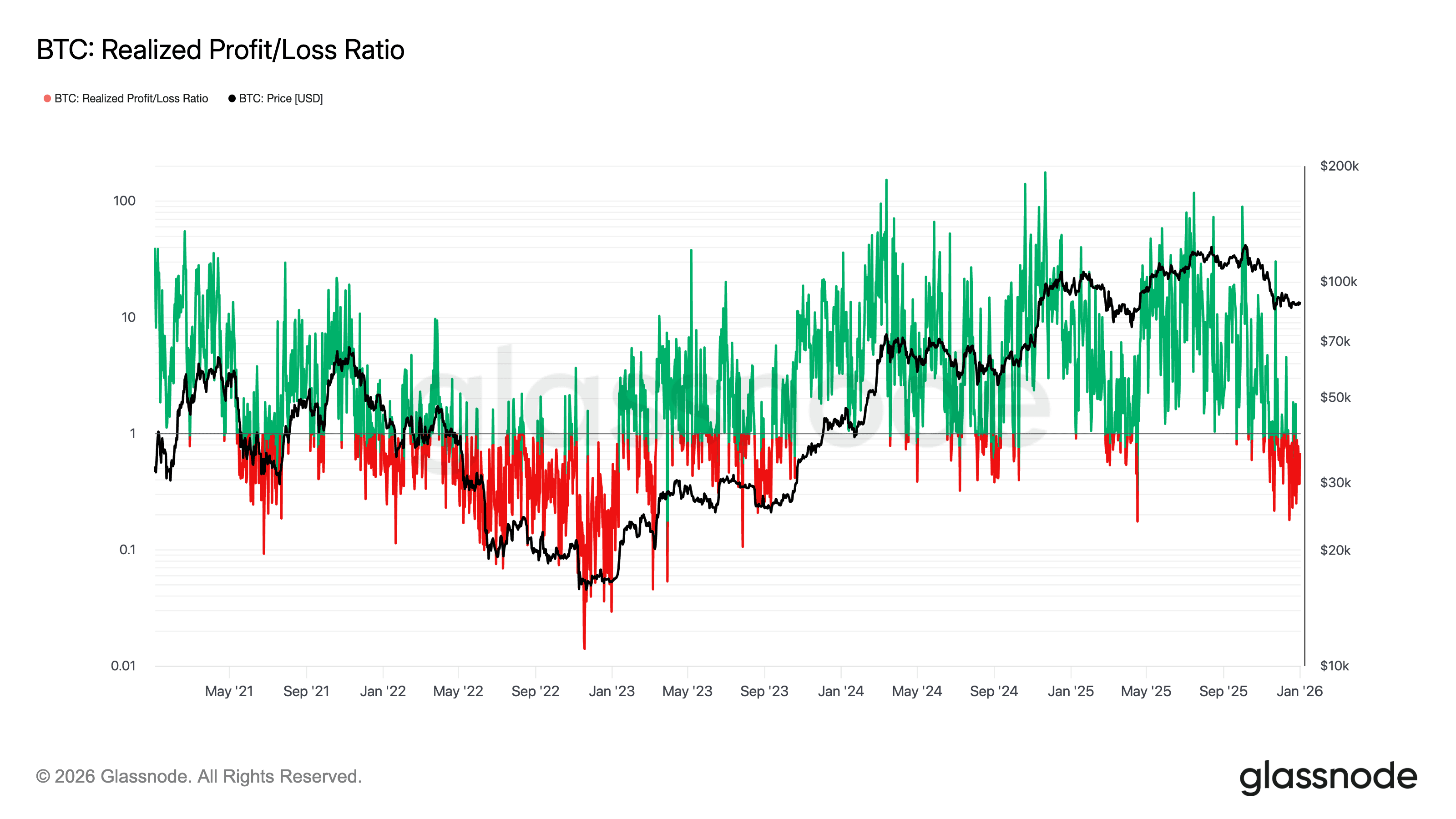
The Realized Profit/Loss (PnL) Ratio in logarithmic scale measures the aggregate USD value of profits versus losses realized by investors over time. When this ratio is above 1, the market is realizing more profits than losses, which is indicative of a confident or bullish environment. Conversely, a ratio below 1 indicates more coins are being sold at a loss, often aligned with bearish sentiment or capitulation. This version of the metric applies a 30-day moving average to smooth out short-term volatility and better identify market phases.
The Realized Profit Loss Ratio trended lower over the quarter and spent an increasing share of time fluctuating around and below the 1.0 threshold. This behavior indicates a shift toward a more balanced or loss weighted realization environment, as a larger proportion of coins were sold at or below cost relative to earlier periods. While the ratio did not remain persistently below 1 for extended durations, repeated dips beneath this level suggest growing hesitation among market participants and reduced willingness to realize profits at prevailing prices. Compared with prior periods where profit realization dominated, the compression in the ratio reflects a cooling in realized gains and a rise in loss realization as price declined and volatility increased. The overall pattern points to weakening realized profitability and heightened sensitivity among sellers as market conditions softened.
Long-Term Holder Net Position Change
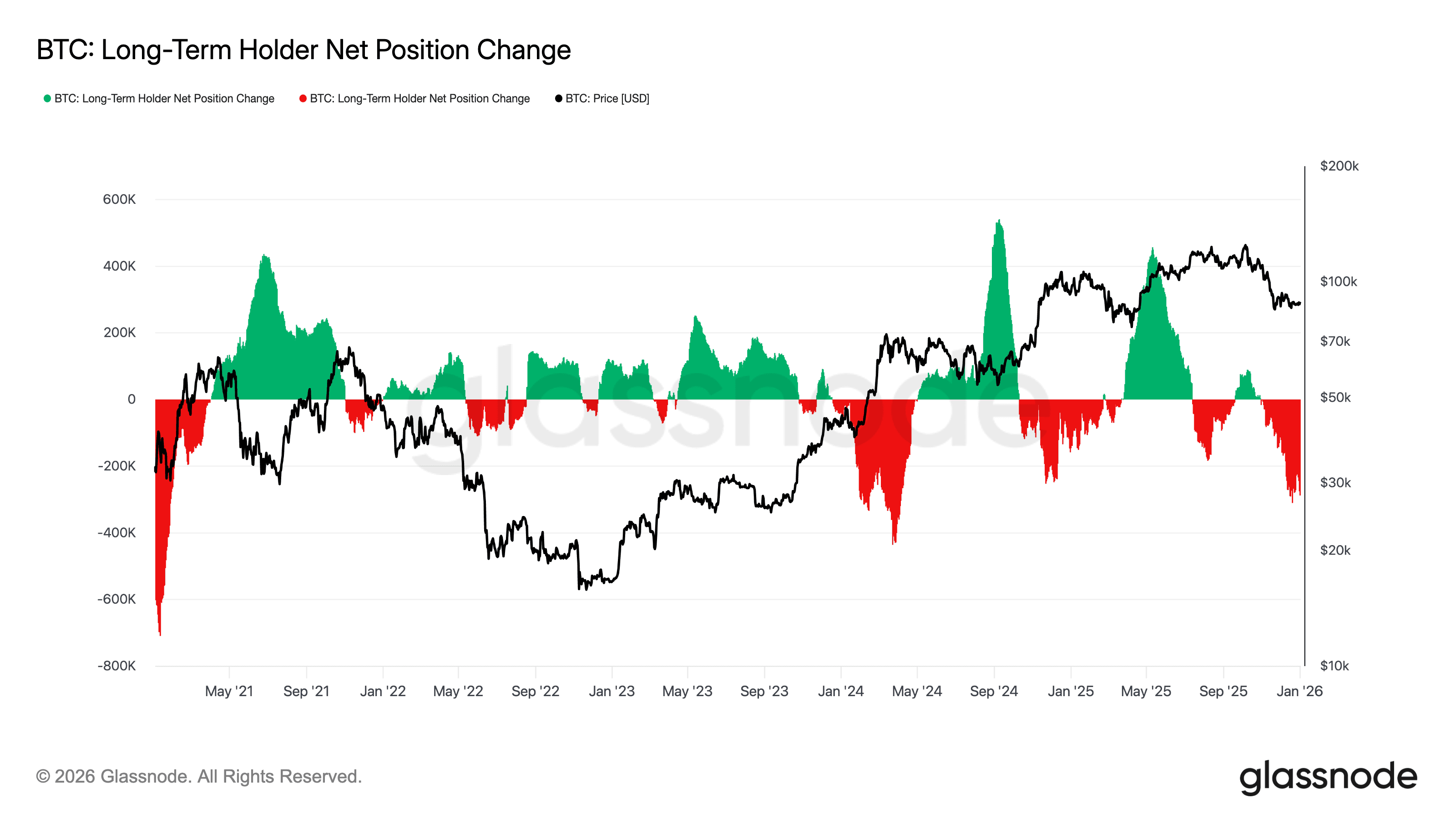
The Long-Term Holder (LTH) Net Position Change metric measures the 30-day net change in Bitcoin supply held by wallets that have held their coins for at least 155 days. When values are positive (green), it signals that LTHs are accumulating Bitcoin. Negative values (red) indicate that LTHs are distributing, often taking profits. Because LTHs are often viewed as strategic investors, their behavior is considered a strong indicator of broader market cycle phases.
Long term holder net position change shifted decisively into negative territory over the quarter, with sustained periods of net distribution replacing the accumulation phases observed earlier in the cycle. The magnitude of outflows increased notably, with several drawdowns exceeding the negative 200,000 to 300,000 BTC range on a rolling 30 day basis. This pattern indicates that long term holders were net sellers during the period, contributing supply back to the market as prices weakened and volatility increased. While intermittent accumulation spikes appeared, they were smaller and shorter lived than prior distribution waves, suggesting that strategic holders reduced exposure more consistently than they added. The persistence and scale of net outflows point to an environment where long term participants actively realized gains or rebalanced holdings rather than continuing to absorb supply.
Long-Term Holder Net Position Change
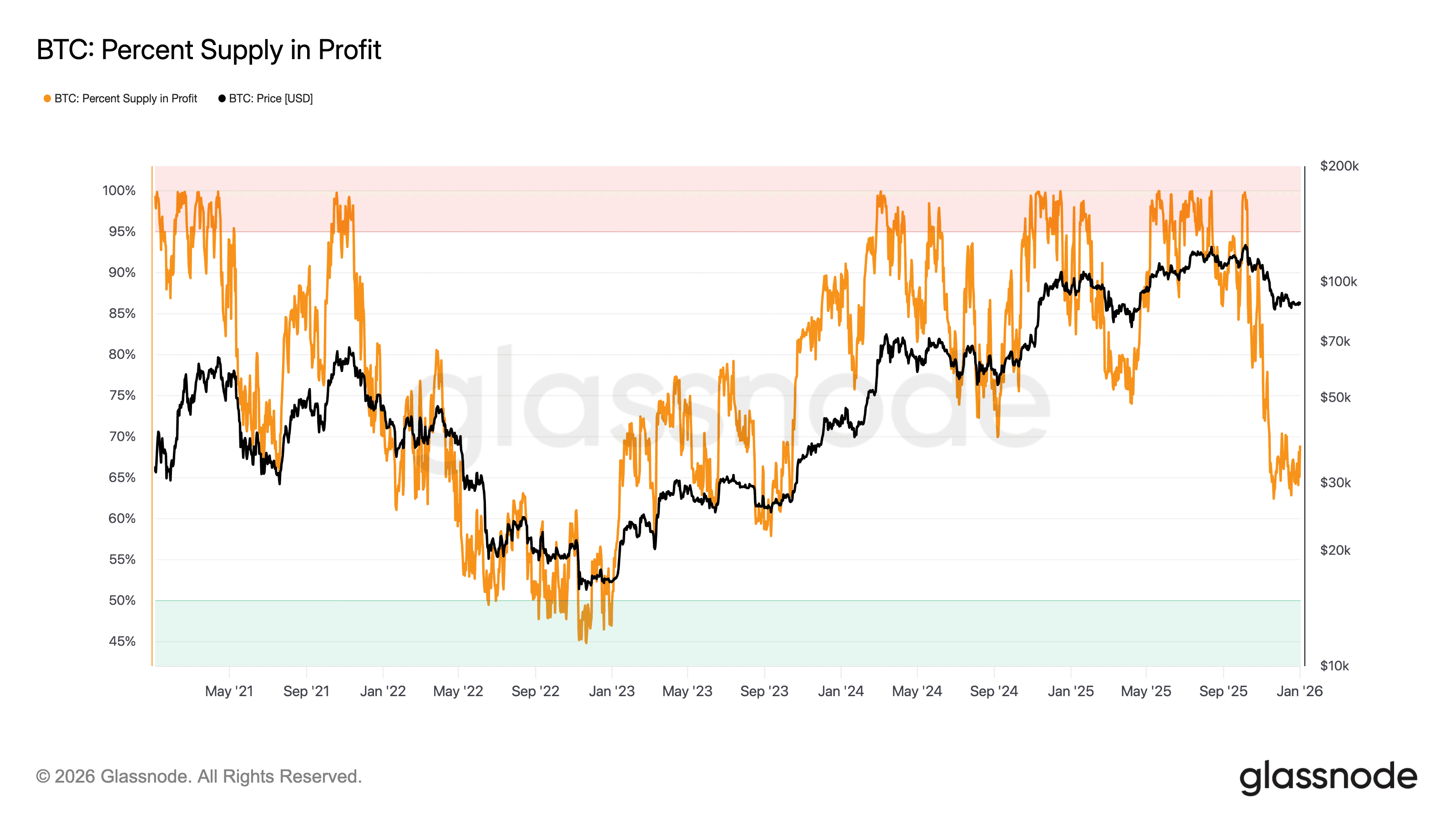
The Percent Supply in Profit chart shows the proportion of Bitcoin's circulating supply that is currently held at a profit. This means the current market price is higher than the price at which each coin last moved. This percentage acts as a broad indicator of market sentiment. High values usually reflect optimism or euphoria, while low values suggest capitulation or bearish conditions.
Percent Supply in Profit declined sharply over the period, falling from levels above 90 percent toward the 65 to 70 percent range as prices retraced from prior highs. This contraction indicates that a meaningful portion of the circulating supply moved from unrealized profit into a neutral or loss position, reflecting the impact of sustained price weakness on holder profitability. While the metric remained well above the sub 50 percent zone typically associated with capitulation, the magnitude of the decline highlights a broad compression in profit distribution across the network. The move away from extreme profit saturation suggests reduced optimism and increased sensitivity to price movements, as fewer coins retained significant unrealized gains compared with earlier phases of the cycle.
Long Term Sentiment Commentary
Taken together, the long term sentiment indicators suggest that the market entered a phase of sustained anxiety and de-risked positioning over the quarter rather than one of outright capitulation. The decline in Entity Adjusted NUPL and Percent Supply in Profit reflects a broad compression in unrealized gains, indicating that profitability across the holder base deteriorated meaningfully as prices retraced. This deterioration was not limited to marginal participants, as evidenced by Long Term Holder Net Position Change shifting into persistent net distribution, signaling that strategic holders contributed supply back to the market rather than absorbing it. At the same time, the Realized Profit Loss Ratio hovering around and below the neutral threshold confirms that realized losses increasingly offset profits, reinforcing a cautious environment. While none of the metrics reached levels historically associated with deep capitulation, their combined direction points to a market where long term confidence weakened materially and risk tolerance declined, suggesting that long term participants spent the quarter reducing exposure and recalibrating expectations rather than reinforcing conviction.
04
Short-Term Sentiment
Entity-Adjusted STH-NUPL
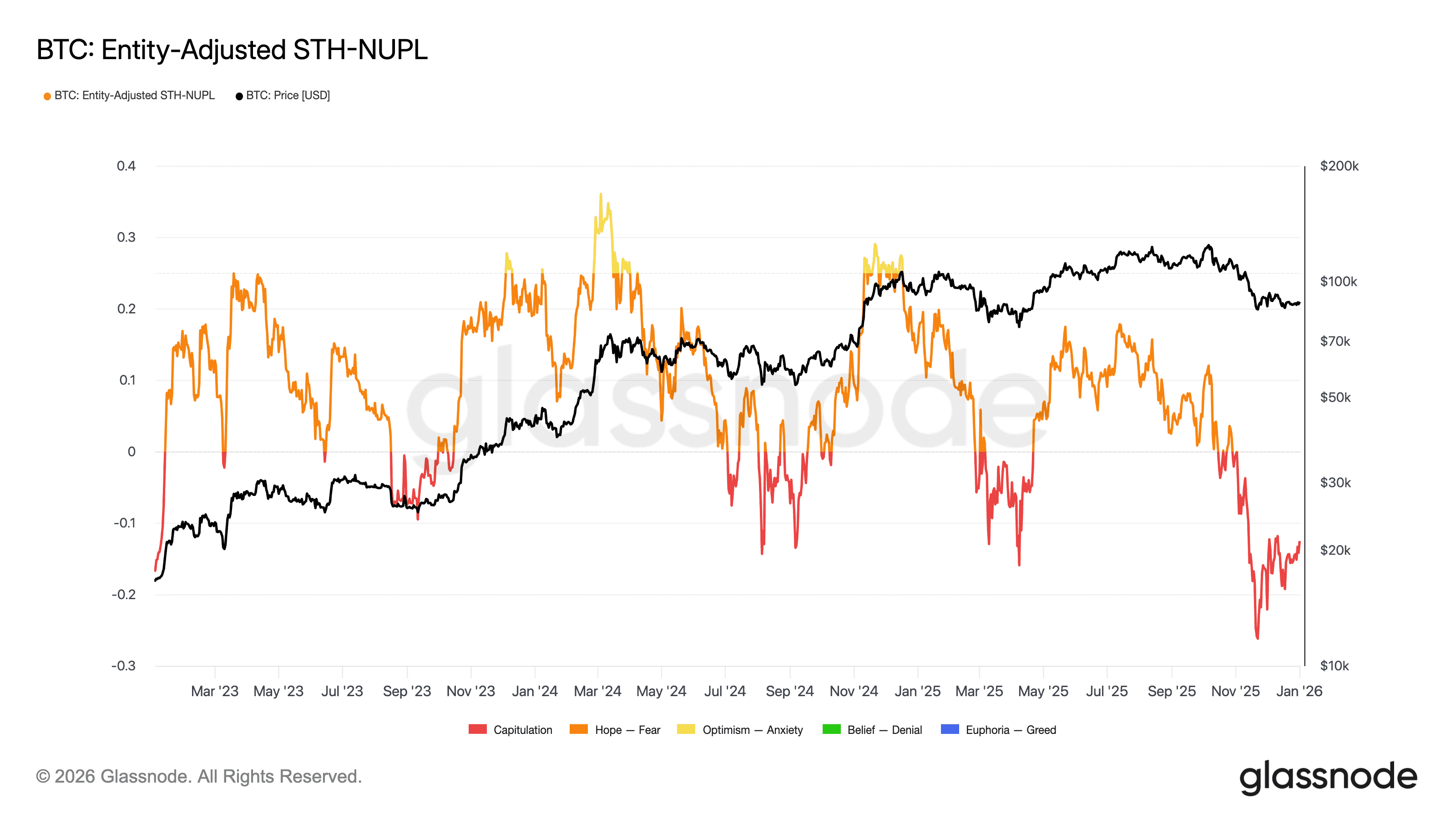
This metric captures the net unrealized profit or loss of Bitcoin held by short-term holders, defined as entities that acquired their coins within the last 155 days. It is calculated by comparing the current market value of short-term holder coins to their cost basis. Positive values indicate that these holders are sitting on unrealized profits, while negative values suggest they are underwater. Because short-term holders are more likely to react emotionally to price swings, this metric provides insight into speculative sentiment and can help identify local tops and bottoms in the market.
Entity Adjusted Short Term Holder Net Unrealized Profit Loss deteriorated materially over the quarter, moving from modestly positive readings into sustained negative territory by the end of the period. Values declined from approximately the 0.10 to 0.15 range toward levels near -0.20, indicating that a majority of short term holders transitioned from holding unrealized gains to sitting at a loss. This shift reflects increasing pressure on more reactive market participants as prices weakened and volatility persisted. The depth and duration of negative readings suggest that short term holders experienced prolonged unrealized losses rather than brief drawdowns, increasing sensitivity to further price movements. Compared with earlier periods where short term sentiment oscillated around neutral or mildly positive levels, the sustained move lower highlights a significant deterioration in speculative positioning and a heightened vulnerability among recent buyers.
Realized-Profit Loss Ratio
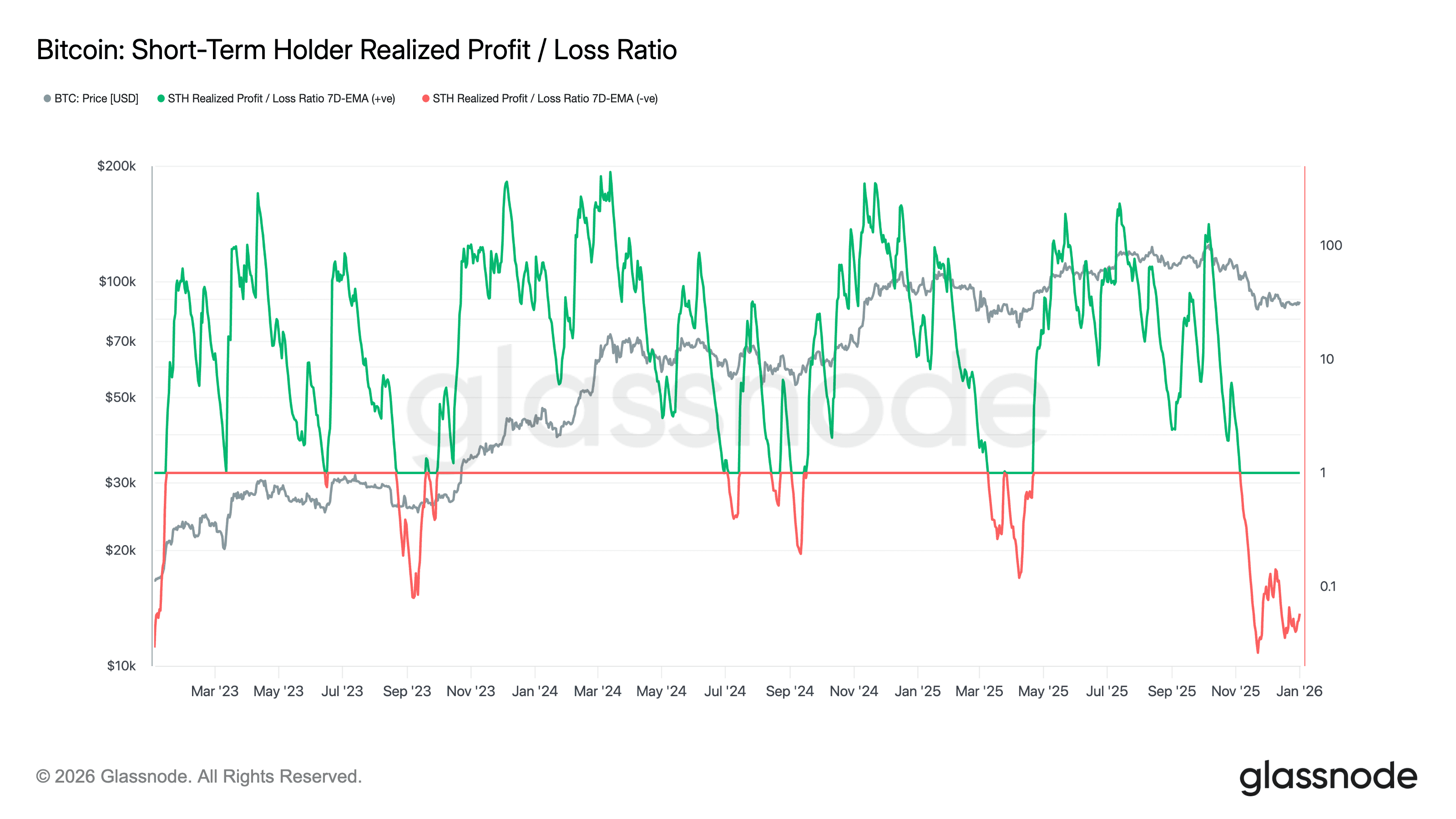
This metric measures the ratio between realized profits and realized losses for short-term holders (STHs), defined as addresses holding BTC for less than 155 days. A ratio above 1 means STHs are realizing more profit than loss, indicating a risk-on or bullish sentiment. A ratio below 1 signals more losses than profits, typically reflecting capitulation or a loss of confidence. Because short-term holders are more sensitive to price movements, this metric offers a real-time view of how speculative participants are behaving and how they are responding to prevailing market conditions.
The Short Term Holder Realized Profit Loss Ratio deteriorated sharply over the period, spending a growing portion of time below the 1.0 threshold. Readings declined from levels that previously reflected dominant profit realization toward sustained sub 1 values, indicating that realized losses increasingly outweighed realized profits among short term holders. Several downside spikes pushed the ratio well below neutral, suggesting periods where loss realization intensified as prices weakened. Unlike earlier phases where recoveries above 1 occurred more frequently, rebounds during this period were shorter lived and less pronounced. The persistence of low readings points to continued stress among recent buyers, with short term participants increasingly forced to realize losses rather than exit positions profitably.
Short-Term Sentiment Commentary
Taken together, the short term sentiment indicators point to a pronounced deterioration in speculative positioning over the quarter, characterized by elevated stress and reduced risk tolerance among recent buyers. The sustained move of Entity Adjusted Short Term Holder Net Unrealized Profit Loss into negative territory shows that a majority of short term participants were holding unrealized losses for an extended period, increasing vulnerability to further price declines. This pressure translated directly into realized behavior, as the Short Term Holder Realized Profit Loss Ratio spent a significant share of time below the neutral threshold, confirming that losses increasingly outweighed profits among speculative participants. The combination of prolonged unrealized losses and repeated loss realization suggests an environment where short term holders were reacting defensively to price weakness rather than positioning opportunistically. While the metrics do not indicate a single capitulation event, their persistence at depressed levels implies sustained fragility in short term sentiment and a continued tendency toward forced selling and risk reduction among recent market entrants.
05
Pricing Models
Realized Price and MVRV
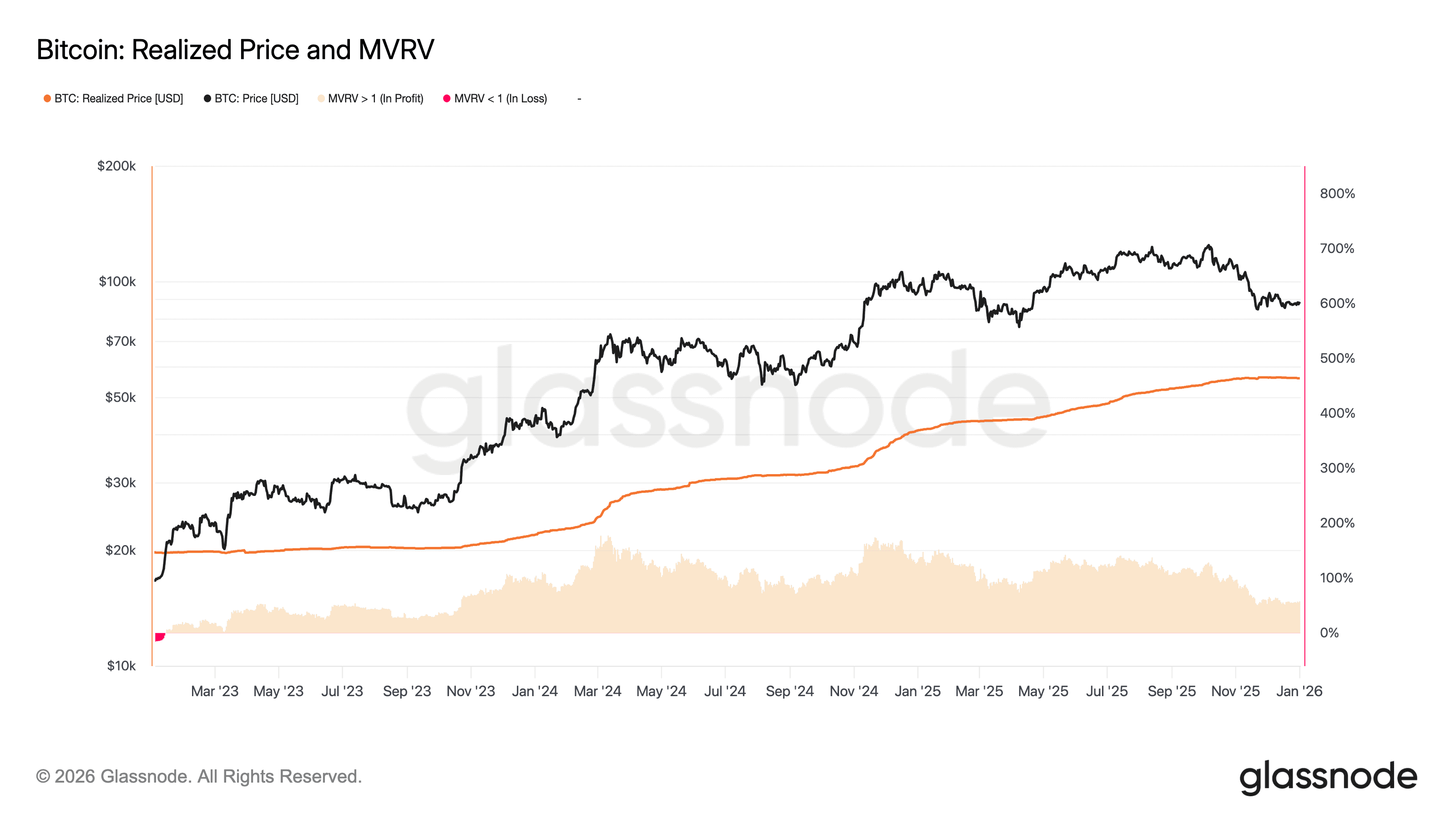
The Realized Price represents the average cost basis of the Bitcoin market and often acts as a foundation during periods of correction, while the Market Value to Realized Value (MVRV) ratio compares market value to that cost basis to gauge overall valuation extremes. MVRV values above 1 indicate that the market is, on average, in profit, while readings above 2.5 have historically coincided with overheated conditions and cycle tops. Together, these metrics illustrate how far market pricing has moved from its aggregate cost structure and help identify periods of either undervaluation or excess.
Market price remained consistently above Realized Price throughout the period, even as prices declined from prior highs. Although price retraced materially, it did not approach Realized Price, a level that has historically marked periods of widespread loss realization and market stress. Over the same period, the MVRV ratio declined toward the 1.6 to 1.8 range, reflecting a meaningful contraction in valuation as unrealized gains compressed. Despite this adjustment, MVRV remained above the 1.0 threshold and below levels historically associated with overheated market conditions. These signals indicate that prices pulled back from stretched levels but remained well supported by the market’s underlying cost base.
Bitcoin: Long-Term vs Short-Term Holder Cost Basis
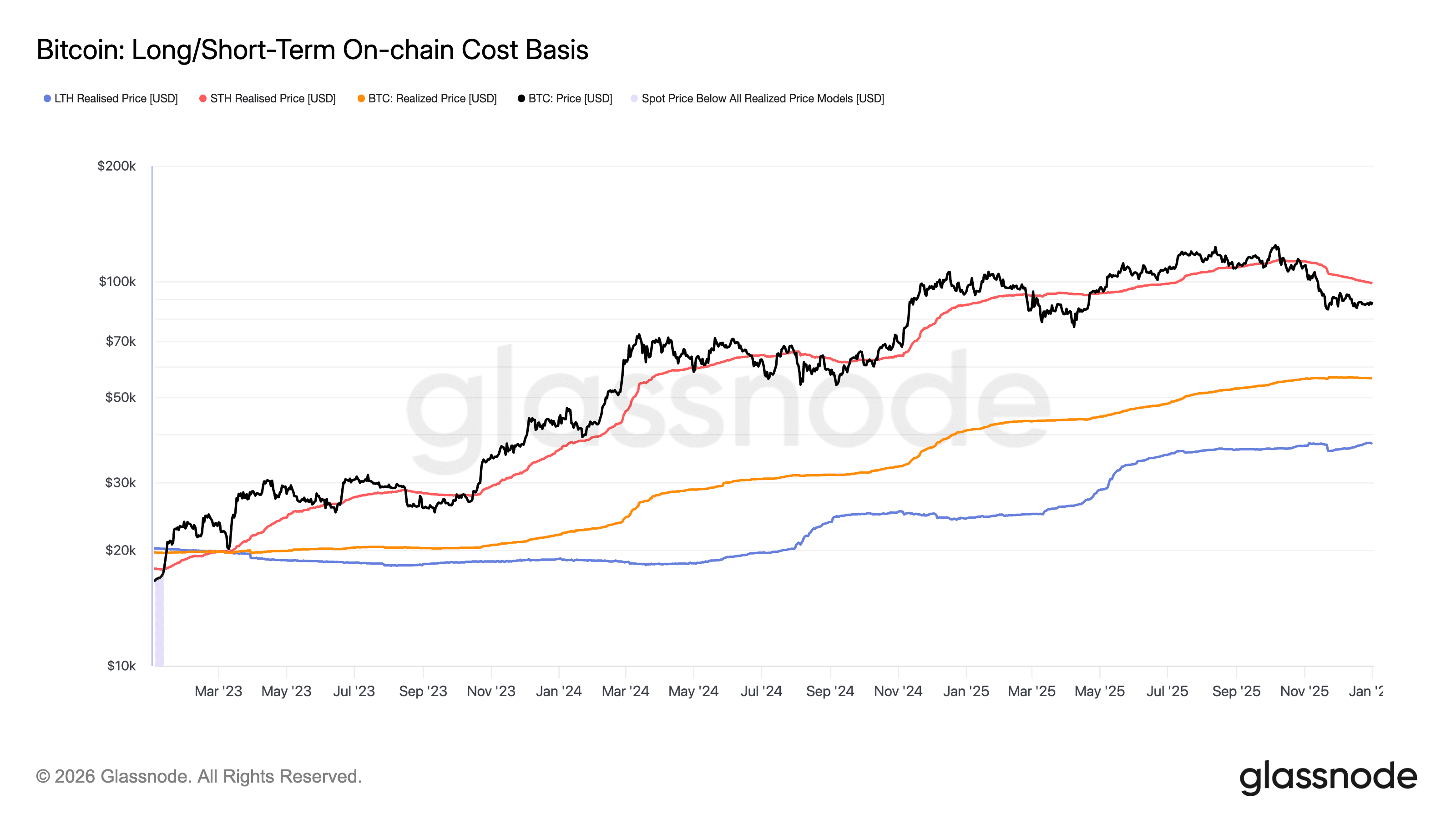
The Long/Short-Term Holder Cost Basis model compares the average purchase price of two distinct investor groups. Long-term holders (LTHs), who have held their Bitcoin for more than 155 days, typically represent market conviction and macro support levels, while short-term holders (STHs), who acquired coins within the past 155 days, reflect more reactive and speculative sentiment. When the current price trades above the STH cost basis, it signals that recent investors are in profit, which often correlates with bullish momentum. Conversely, when the price falls below the STH cost basis, it indicates newer buyers are underwater and may panic sell. Meanwhile, the LTH cost basis tends to act as a strong floor in bear markets, rarely breached unless under extreme stress.
Market price remained positioned between the long term holder and short term holder cost bases over the period, trading well above the long term holder realized price while oscillating around the short term holder realized price. The long term holder cost basis continued to rise steadily into the low to mid 30,000 dollar range, reinforcing its role as a deep structural support level. In contrast, the short term holder cost basis flattened and began to roll over near the 95,000 to 100,000 dollar range as prices declined, indicating that a large portion of recent buyers moved into an unrealized loss position. This configuration reflects a widening divergence between strategic holders who remained comfortably in profit and more reactive participants who faced increasing pressure. The sustained separation between price and the long term holder cost basis suggests that broader market structure remained intact, while weakness relative to the short term holder cost basis highlights ongoing stress among newer market entrants.
Pricing Model Commentary
The pricing model indicators suggest that the market entered a bearish repricing phase over the quarter, driven by weakening sentiment and a clear reduction in risk appetite. The compression in MVRV from elevated levels toward a more moderate range reflects a meaningful contraction in valuation, signaling that prior excesses were unwound as momentum faded. This repricing occurred alongside increasing stress among short term participants, as price weakness pushed recent buyers into unrealized losses and reduced their ability to exit positions profitably. While market price remained above Realized Price and well above the long term holder cost basis, these deeper structural supports functioned more as distant backstops than active sources of confidence. In aggregate, the signals point to a market environment characterized by bearish sentiment and deteriorating pricing dynamics, with structural integrity intact but insufficient to offset the prevailing downward pressure on valuation and risk taking behavior.
06
News
Bitcoin Mining

Core Scientific Terminates Merger Agreement With CoreWeave
Core Scientific formally terminated its proposed merger with CoreWeave after shareholders rejected the transaction. The decision highlighted valuation disagreements and strategic uncertainty surrounding the combination of Bitcoin mining infrastructure with AI-focused compute platforms, marking a setback for large-scale consolidation efforts in the sector.
Crypto Winter Squeezes Bitcoin Miners as Post-Halving Margins Compress
Following the 2024 halving, Bitcoin miners faced sustained margin compression as higher difficulty and lower hashprice reduced profitability. In response, many operators cut capital expenditures, delayed expansion plans, and shifted focus toward liquidity preservation and operational efficiency.


Governments Reassess Energy Policy as Data Center Demand Accelerates
Governments and grid operators increasingly reassessed energy policy as demand from large data centers, including Bitcoin mining and AI workloads, continued to grow. The discussion shifted toward grid stability, pricing mechanisms, and the role of flexible and interruptible industrial loads within national energy planning.
News Commentary
Q4 2025 marked a clear transition point for the Bitcoin mining industry as capital discipline replaced growth at all costs strategies. The termination of the Core Scientific and CoreWeave merger illustrated the sector’s growing resistance to large speculative consolidation without clear economic alignment, particularly in a post halving environment.
Margin compression forced miners to prioritize balance sheet strength and efficiency over hashrate expansion, reinforcing a more mature operating mindset. At the same time, increased government focus on energy policy and data center demand signaled a broader reframing of Bitcoin mining as critical infrastructure competing for power alongside AI and cloud computing.
07
Mining Dashboard
Bitcoin: Difficulty per Issuance Pricing Model
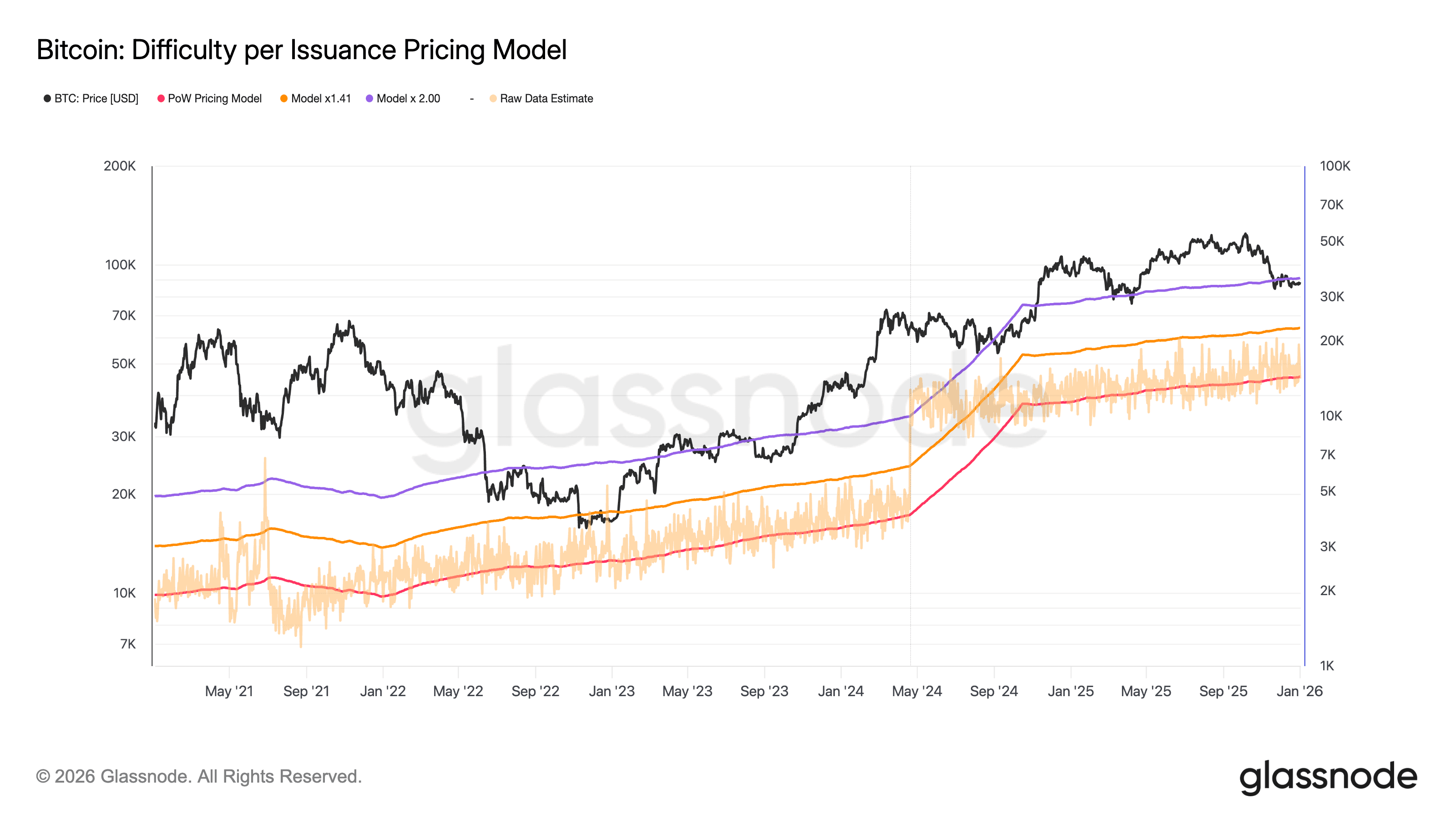
The Difficulty per Issuance Pricing Model is a miner-centric valuation tool that establishes a lower bound estimate for Bitcoin’s fair value by combining two key variables: network difficulty and issuance rate. Difficulty reflects the computational effort required to mine blocks, serving as a proxy for capital investment and network security. Issuance refers to the number of new BTC created through mining, which diminishes over time as halvings occur. This model uses a smoothed average of difficulty and adjusts for reduced issuance, yielding a dynamic cost-floor estimate that reflects the production pressures on miners. As difficulty rises and issuance drops, the modeled price increases, anchoring the long-term market structure to miner behavior and economic feasibility.
Market price remained above all modeled production cost bands throughout the period, despite a material decline from prior highs. The Difficulty per Issuance model continued to trend higher as network difficulty increased and issuance declined, pushing the estimated cost floor upward over the quarter. On a quarter over quarter basis, the base pricing model increased by approximately 10 to 15%, rising into the low to mid $40,000 range, while the higher multiplier bands advanced by a similar magnitude toward the $60,000 to $80,000 range. Although price moved closer to these modeled levels as the quarter progressed, it did not breach them, indicating that market pricing remained above estimated miner production costs. The narrowing distance between spot price and the modeled cost bands reflects tightening miner margins and increased production pressure, even as the model continued to signal a rising long term cost structure driven by sustained difficulty growth.
BTC: Miner Net Position Change
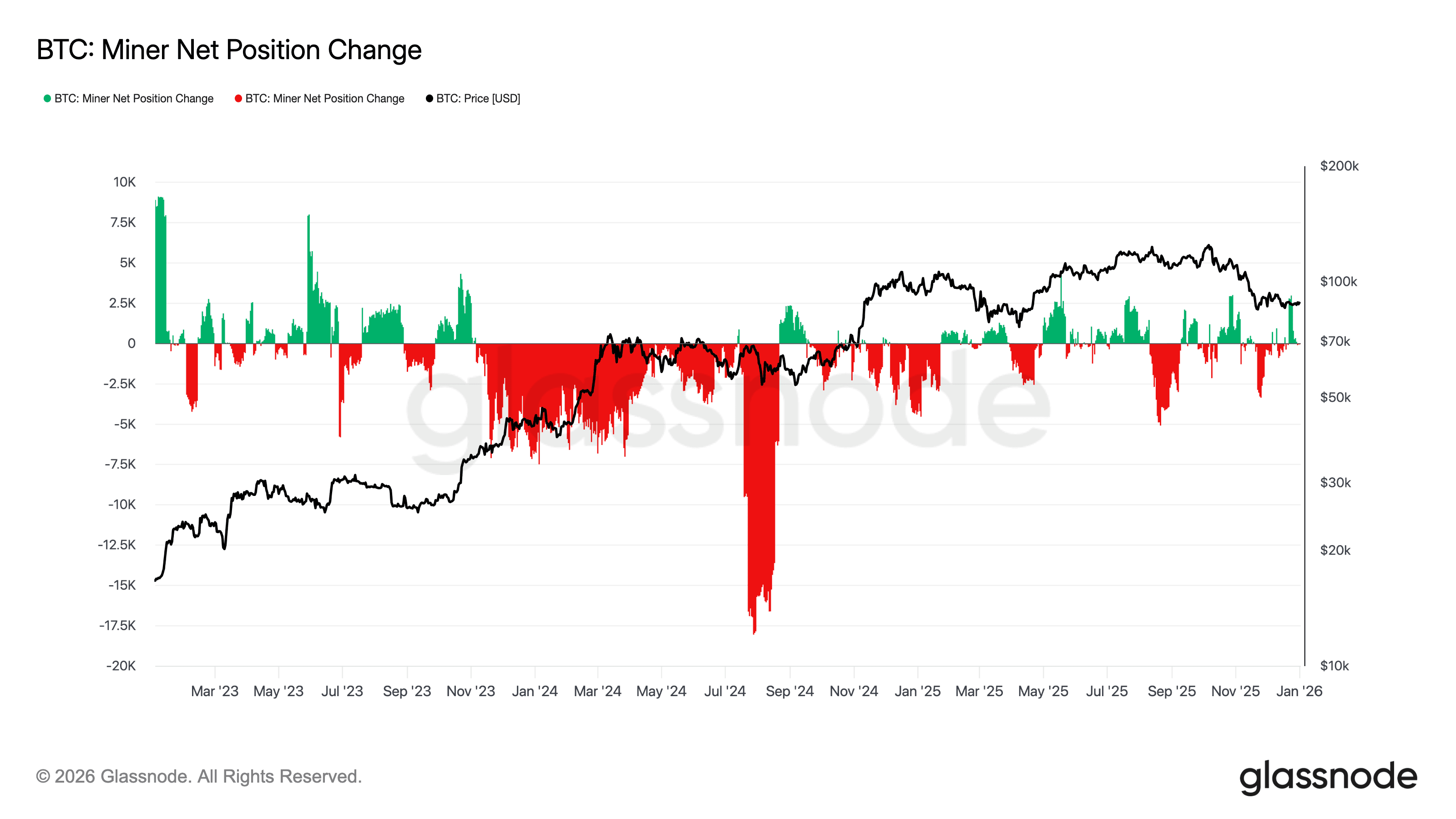
The Miner Net Position Change metric captures the 30-day rolling change in the Bitcoin balances of miner wallets. A positive value suggests miners are accumulating BTC, either by holding newly mined coins or withdrawing fewer from treasury. A negative value reflects distribution, typically selling to meet operational costs or capitalize on favorable prices. As miners are a consistent source of natural sell pressure, their behavior offers critical insight into macro supply dynamics. Accumulation implies long-term confidence and reduced immediate sell pressure, while distribution can create headwinds during uptrends or signal underlying stress during drawdowns.
Miner Net Position Change remained predominantly negative over the period, indicating sustained net distribution from miner wallets. Several distribution phases reached magnitudes in excess of 10,000 BTC on a rolling 30 day basis, reflecting elevated sell pressure as prices declined and operating margins tightened. While brief accumulation episodes appeared intermittently, they were smaller in scale and shorter in duration than preceding distribution waves. This pattern suggests that miners prioritized liquidity and operational funding over balance accumulation, particularly as hashprice compressed and production costs rose. The persistence of net outflows highlights a supply environment where miners continued to contribute incremental selling pressure rather than acting as a stabilizing force through accumulation.
Bitcoin: ASIC Rig Profitability (Antiminer S21 Pro)
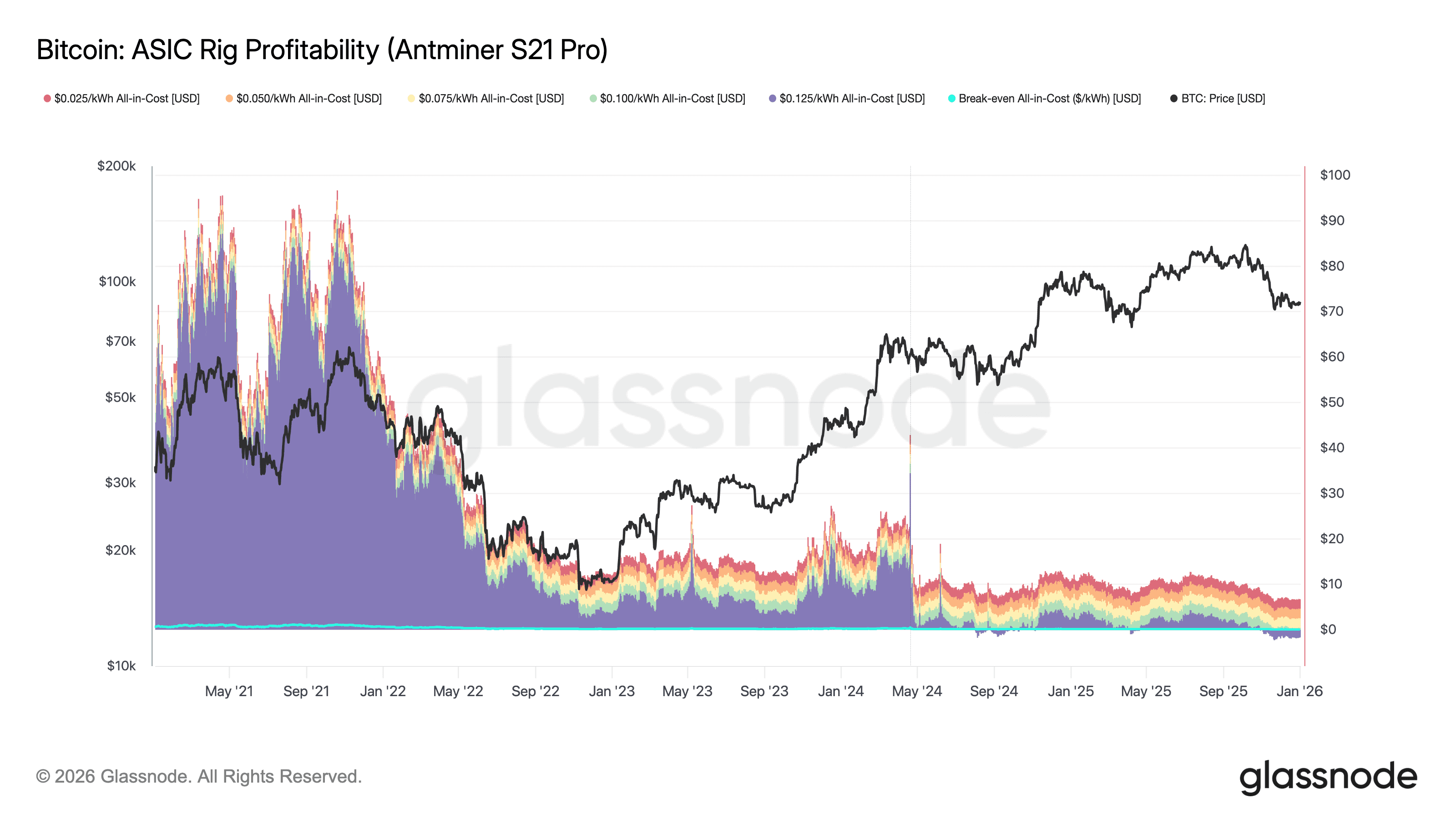
The ASIC Rig Profitability metric for the Bitmain Antminer S21 Pro tracks estimated daily profits under various all-in energy cost assumptions, ranging from $0.025 to $0.125 per kWh. It calculates profitability by subtracting the rig’s daily operating cost from its estimated block reward revenue based on a 218 TH/s hashrate and 3660W power consumption. Each band in the chart represents profitability at a different energy price point. This model is crucial for identifying breakeven thresholds and evaluating miner health under changing market conditions, especially across varying operational cost environments.
ASIC rig profitability deteriorated meaningfully over the period across all energy cost tiers as hashprice declined and network difficulty increased. At lower cost levels near $0.05 and $0.06 per kWh, daily profitability remained positive but narrowed materially, indicating that efficient operators continued to operate above breakeven with thinner margin buffers. In contrast, operators facing $0.075 and $0.08 per kWh all in energy costs, categorized here as retail miners, experienced profitability that oscillated near breakeven and frequently slipped into loss territory. These higher cost cohorts showed limited tolerance to price weakness and rising difficulty, with extended periods where daily returns were marginal or negative. The widening gap between low cost operators and retail miners highlights a bifurcated operating environment, where access to sub $0.07 per kWh energy increasingly defined survivability, while higher cost participants faced sustained economic pressure as network conditions tightened.
Mining Dashboard Commentary
Taken together, the mining dashboard indicators point to a materially more challenging operating environment over the quarter, driven by rising production costs and weakening revenue dynamics. The upward shift in the Difficulty per Issuance model shows that the implied cost floor continued to climb as difficulty increased and issuance declined, narrowing the gap between market price and miner breakeven levels. This pressure translated into observable behavior, as Miner Net Position Change remained predominantly negative, indicating that miners were net distributors of BTC and relied on consistent selling to fund operations rather than accumulating balances. At the same time, ASIC rig profitability data highlights a widening divide between low cost operators and retail miners, with profitability remaining viable at sub $0.06 per kWh while higher cost cohorts near $0.075 to $0.08 per kWh frequently operated at or below breakeven. These signals suggest that the quarter was defined by margin stress and supply side pressure, where survivability increasingly depended on access to low cost energy and efficient operations, and where miners responded to tighter economics through sustained distribution and restrained reinvestment rather than expansion.
Conclusion
The fourth quarter 2025 highlighted a clear shift in market behavior, with sentiment and risk appetite deteriorating across both investors and miners. Bitcoin’s price decline, combined with weaker on-chain profitability metrics, showed that participants spent the quarter managing downside risk rather than positioning for growth. Long-term holders reduced exposure, short-term holders absorbed losses, and valuation metrics reset from elevated levels, all pointing to a market under pressure but not structurally broken. The dominant theme of the quarter was caution, as confidence faded and participants adjusted expectations in response to tightening financial conditions.
For miners, this environment translated into real operational strain. Rising network difficulty and falling hashprice compressed margins, widened the gap between low-cost and higher-cost operators, and forced continued selling to fund operations. Hardware prices and profitability data reinforced the importance of energy access and efficiency, as only the most competitive operators maintained resilience. Q4 was a period of consolidation and stress testing for the Bitcoin ecosystem, where survival, discipline, and positioning took precedence over expansion, and where the outlook became increasingly dependent on broader macro conditions and the market’s ability to absorb ongoing supply.